
I bought the Williams AV Pocketalker Ultra because Carol got tired of the television shaking the pictures on the wall. That is the short version. The longer one is that I have mild to moderate hearing loss in both ears, worse on the left, from thirty-eight years of running conduit and pulling wire next to equipment that did not care about my ears. Consonants are the hard part. Women's voices and children's voices are harder. Television dialogue with music underneath it is the daily problem. I am seventy-one, I live in Rolla, Missouri, and I am not an audiologist, so nothing in this review is medical advice. It is one man's report after most nights of a year with a small box hanging from a lanyard around his neck.
An honest review has to start with what the thing is not. It is not a hearing aid. It does not get programmed to your audiogram, it does not know which frequencies you are missing, and it will not pull a voice out of a room full of clattering dishes the way a properly fitted aid can. What it does is simpler and, for me, more useful most evenings. It takes sound from a microphone you place yourself and puts it into your ear at a volume you set with your own hand. That is the whole idea. Williams AV has been building this same basic box for a long time, and it shows in the small details more than in the big ones.
The Quick Verdict
A plain, well-built amplifier for television and one-on-one conversation. It does exactly what the box says, and it takes a couple of weeks to learn where to point the microphone.
Amazon Check Today's Price →Two knobs, no pairing, and the volume fight ends tonight
Runs on two AAA batteries, up to 200 hours. Folding headphones, a mini earbud, a plug-in microphone, a 12-ft TV cord and a lanyard come in the box.
Amazon Check Today's Price on Amazon →How I Actually Use It
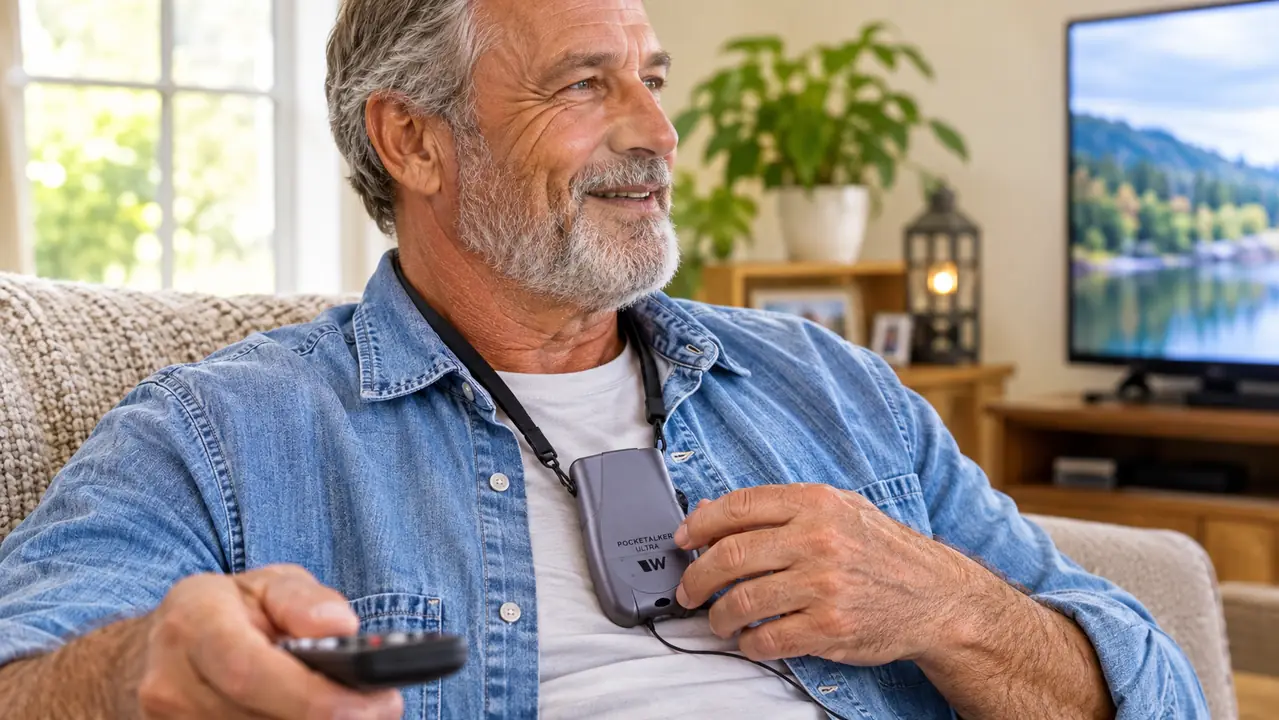
Setting it up took one evening, and most of that was me being stubborn about how the cord ran. The television is a 55-inch set about eleven feet from my recliner. The plug-in microphone sits near the TV, the 12-ft TV cord runs back to where I sit, and the unit hangs on the lanyard around my neck. There is no pairing, no app, and no menu to dig through. That is the part I appreciate most at my age. I have spent enough evenings helping Carol with the printer to know I do not want a hearing device that asks for a password.
Power comes from two AAA batteries, and the listing says up to 200 hours. I have not sat with a stopwatch, but I put a set in during the fall and was still using them well into the winter, running it an hour or two most nights. I keep a spare pair in the drawer beside the recliner anyway. Old electrician habit, and one less thing to think about.
A typical evening goes like this. News at six, headphones on, volume about a third of the way up, tone knob turned toward the treble side. Carol reads in the chair across the room with the television at a level she can ignore. Before this device, that same hour was a negotiation that ended with both of us irritated. That is the honest case for the thing, and it has nothing to do with specifications.
The tone knob turned the other way makes everything thick and muddy. For my ears that is the wrong direction, because thick sound is exactly where the ends of words go to die. I can raise the treble until I hear consonants again, and I can do it without touching the television volume. Two knobs, one for how loud and one for how bright, and after a month my fingers knew where both of them were without me looking.
The First Two Weeks
The first two weeks were not smooth. I had the microphone clipped to the television cabinet at first, which picked up a rattle from the cabinet door every time the bass hit. I moved it and the rattle went away. Then I had the volume too high and everything sounded like a public address system. Then I had the tone too low and could not understand a word. None of that is a flaw in the device. It is what happens when you hand a new tool to a man who would rather adjust it than read about it.
What I would tell a new owner is to spend the first week moving one thing at a time. Set the tone knob where voices sound normal to you, then leave it alone and use only the volume. Then find the spot for the microphone where the sound is cleanest and mark it. Once those two things are settled, you will not touch them again for months.
The Two Knobs Are the Whole Point
There are two large knobs on the face of the unit, one for volume and one for tone, and they are big enough to find by feel in a dim room. That matters more than it sounds like it would. No apps, no pairing, no programming, and a red LED so you can see the unit is running. That is the entire interface. When my daughter tried it during a visit, she had it going in under a minute without me saying a word. Compare that to anything with a touchscreen and a firmware update waiting for you.
The automatic gain control is the other piece worth explaining in plain language. It keeps sudden loud sounds from jumping out at you. When a commercial comes on louder than the program, or a pan gets dropped in the kitchen, the device reins it in instead of letting it hit your ear at full force. It is not instant and it is not perfect, but after a year I can count on one hand the times something made me flinch. The frequency range is listed as 20 Hz to 20 kHz, which for a box like this mostly means it will not sound like a cheap telephone.
I can raise the treble until I hear consonants again, and I can do it without touching the television volume.
What Nobody Tells You About the Microphone
Nobody tells you that the microphone placement matters more than the volume knob. That little plug-in microphone is doing all the work, and where you put it decides whether you hear the ball game or the refrigerator. Clip it near the television speaker and the sound is clean. Set it on the end table and you get the room instead. It took me two weeks of fiddling before I stopped moving it around, and the spot I finally chose is not where I started.
At the kitchen table I use it without the television cord, with the microphone laid flat between me and whoever is talking. That is where it surprised me. Carol and I can talk at a normal volume instead of me saying what at the end of every other sentence. At church I set it on the pew beside me, pointed forward, and I follow the sermon better than I have in years. In a big room with a sound system it is not the same as the assistive listening setup the church already has. In a small room it does the job.
The catch is that it picks up everything, and everything includes the air conditioner, the dishwasher, and a napkin being crumpled. In a loud restaurant it is close to useless, because it amplifies the clatter as faithfully as it amplifies the voice. It is a microphone in a box, not a machine that sorts out what you want to hear. Once I understood that, I stopped being annoyed by it and started being smarter about where I pointed it, which is a nicer way of saying I stopped expecting it to do something it was never built to do.
Headphones, Earbud, or Neither
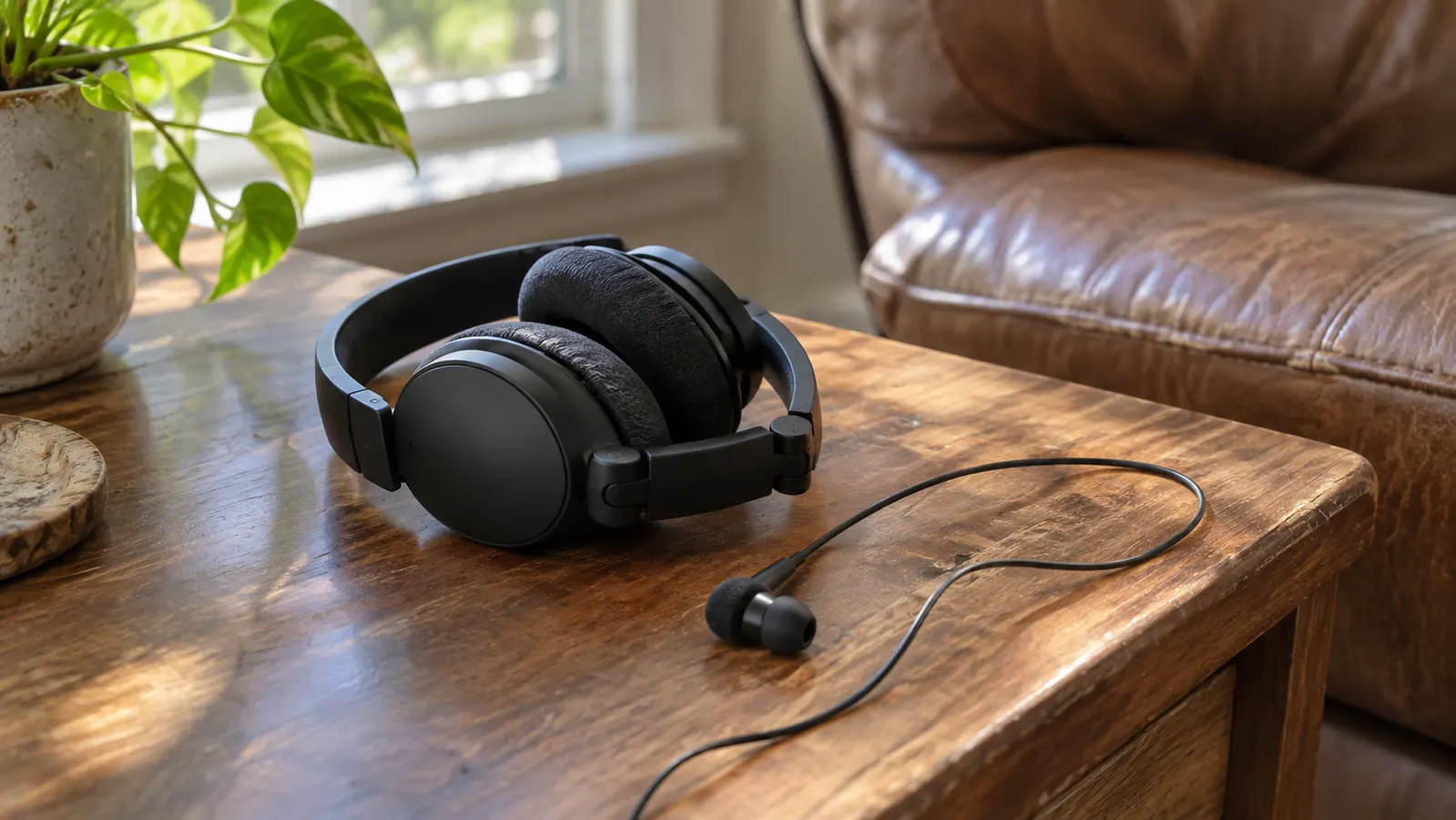
The box comes with folding headphones and a mini earbud. The headphones sit on the ear rather than around it, and they fold flat, so they live in the drawer beside the recliner without taking up space. The earbud fits in the ear and is far less noticeable. For television at night I use the headphones, because they knock down a little of the room noise and I do not have to have anything pushed into my ear canal for two hours straight.
For daytime conversation I use the earbud. It is lighter, and I can hear Carol call from the kitchen while it is still in. The tradeoff is that anything that fits well enough to sound good for an hour starts to feel like a pebble after three. That is not a knock on this device in particular. It is what happens when you leave something in your ear all afternoon.
Where It Comes Up Short
The cord is my main complaint. Twelve feet sounds like plenty until you have a recliner, a dog, and a wife who likes the furniture arranged a certain way. I have yanked the unit off my neck twice standing up without thinking. The lanyard and clip help, and I eventually learned to unclip before I stand, but it is still a cord, and cords catch on things. If a wireless version existed with the same two knobs, I would be first in line.
It runs on disposable batteries with no rechargeable option, which means you are buying AAA cells for as long as you own it. Over a year that is not many, but it is one more line on the shopping list. The housing is plastic and it feels like a plastic box, because that is what it is. Williams AV covers parts and labor for five years and accessories for 90 days, which tells you what they expect to wear out first. The short accessory coverage is worth knowing before you order a replacement cord.
And there is no way to tune it to your particular hearing loss. You get volume and tone, and you work with what you have. For my shape of loss that has been enough. For somebody with a different shape of loss it may not be, and no review from a retired electrician can tell you which one you are. That is what the hearing test is for.
What I Liked
- Two knobs and no menus, so anyone can run it in a minute
- The tone control brings consonants back on television dialogue
- Automatic gain control keeps loud commercials from jumping out
- Folding headphones, a mini earbud, a plug-in microphone, a 12-ft TV cord and a lanyard all come in the box
- Battery life is long enough that I forget when I last changed them
- Five-year warranty on parts and labor
Where It Falls Short
- The 12-ft cord catches on furniture when you stand up
- No rechargeable option, it takes two AAA cells at a time
- Picks up room noise as faithfully as it picks up voices
- You cannot tune it to your own hearing loss
- The headphones feel heavy after a couple of hours
How It Held Up Over a Year
A year in, the knobs still turn smoothly with no scratchiness, which was the failure I expected first. The 12-ft TV cord is the part that gets abused, and mine has a slight kink near the plug, but it still works. The folding headphones have held up better than I thought they would, given that they get folded and unfolded almost every night and dropped in a drawer.
The bigger change was not in the device. It was in the house. Carol stopped asking me to turn it down. I stopped pretending I could hear the dialogue and then asking her what happened. We watch the evening news together again instead of me watching it alone at a volume that ran her out of the room. That is not a line on a spec sheet, but it is the reason I kept using the thing after the first month, and it is the reason I am still using it now.
Who This Is For
This is for the person who hears fine in a quiet room but loses the thread the moment there is background noise, background music, or a face turned away. It is for someone whose family has started repeating things, and who is not ready for a hearing aid or has been told they are not a candidate yet. It is also for someone who already wears aids and wants something simpler for the television. Get your hearing tested. My audiologist checks mine every couple of years and she had no objection to me using this, but she was clear that it does not replace the test or the aids.
Who Should Skip It
Skip it if your loss is worse than moderate, because no amount of knob turning replaces amplification fitted to your ears. Skip it if most of your trouble is in restaurants and crowded rooms, because a microphone in a box cannot sort a voice out of a din of dishes. Skip it if you want something you never have to think about, because this has a cord, a lanyard, and batteries, and you will think about all three. And skip it if appearances matter more to you than sound. It is not invisible.
What I'd Tell a Friend
If you asked me at the kitchen table, I would say this. Get your hearing checked first. Then try something like this to find out what amplification actually does for you before you spend real money on anything bigger. The Pocketalker Ultra is a plain tool that does a plain job. It will not make your ears twenty years younger and it will not win a design award. It will let you watch the ball game with your wife in the room, and around here that turned out to be worth more than I expected.
One box, two knobs, and the TV at a volume we can both live with
Folding headphones, a mini earbud, a plug-in microphone, a 12-ft TV cord and a lanyard come in the box. Two AAA batteries, up to 200 hours, and a five-year warranty on parts and labor.
Amazon Check Today's Price on Amazon →