Two small boxes, both battery powered, both built to put a little more sound in your ear. That is about where the family resemblance ends. I am 71, I spent 38 years around job-site noise as an electrician, and I have mild to moderate high-frequency hearing loss in both ears, worse on the left. Carol, my wife, can tell you the exact volume number she used to put up with on the television. The Williams AV Pocketalker Ultra is the one that ended up on the arm of my recliner. The SuperEar SE5000 is the one I borrowed for three weeks to see whether I was missing anything. Short answer: for the television and the kitchen table, the Pocketalker Ultra is the easier thing to live with. For hearing one person in a checkout line, the SE5000 is the easier thing to carry.
Neither of these is a hearing aid, and I want that said plainly before we go further. They are personal amplifiers. A microphone picks up sound, a wire or a bud puts it in your ear, and a control makes it louder. Nothing gets programmed to your ears, no audiologist is in the room, and you are the one doing the adjusting. I had my hearing tested at 66 and I would tell anybody reading this to do the same before spending money on either device. What follows is an account of daily life with both units. It is not medical advice and I am not qualified to give any.
| Williams AV Pocketalker Ultra | SuperEar SE5000 | |
|---|---|---|
| Controls | Two large knobs, one for volume and one for tone, easy to find by feel in a dark room | A single small thumbwheel for volume, and nothing for tone |
| Battery | Two AAA cells, listed at up to 200 hours, and you can buy them at any hardware store in town | Also battery powered, but I was swapping cells more often than I expected |
| Television | Comes with a plug-in microphone and a 12-ft cord, so the audio comes off the set instead of off the room | Meant to pick up room sound through its own microphone, so the television has to be loud enough for the room first |
| Getting started | No pairing, no app, no programming. Batteries in, knob turned | No pairing either, just a switch and a thumbwheel. The quicker of the two to be using |
| Wearing it | Neck worn on a lanyard or clipped to a shirt, with folding headphones or a mini earbud | Small enough to sit in a shirt pocket, and I forgot I had it on |
| Warranty | The listing states five years on parts and labor, with 90 days on accessories | I could not find a comparable term on the SE5000 listing I read |
| Best for | Evenings of television and a table full of people talking | One person, one errand, one quick conversation |
Where the Pocketalker Ultra Wins
The tone knob is the part I did not expect to care about. My hearing loss sits in the high frequencies, so consonants arrive as mush while the bass comes through just fine. Adding volume mostly gave me more bass. Before I spent a dime I tried the free version: I sat closer to the set, then I moved the recliner up about two feet, and then I moved it back because Carol said the room looked wrong. Neither one helped. When I turned the volume up, the bass came at me like a truck and the dialogue stayed behind it. The Williams AV Pocketalker Ultra has two large knobs, one for volume and one for tone, and turning the tone down pulled the rumble out of the room and let the dialogue step forward. It took a couple of evenings to find the right spot. My mistake at first was setting the tone knob too far. Everything went thin and hissy and I decided the unit was no good. Then I backed it off about a third of the way toward the middle and it came right. Carol noticed the change before I was sure of it, and she has normal hearing, so she made a fair judge.
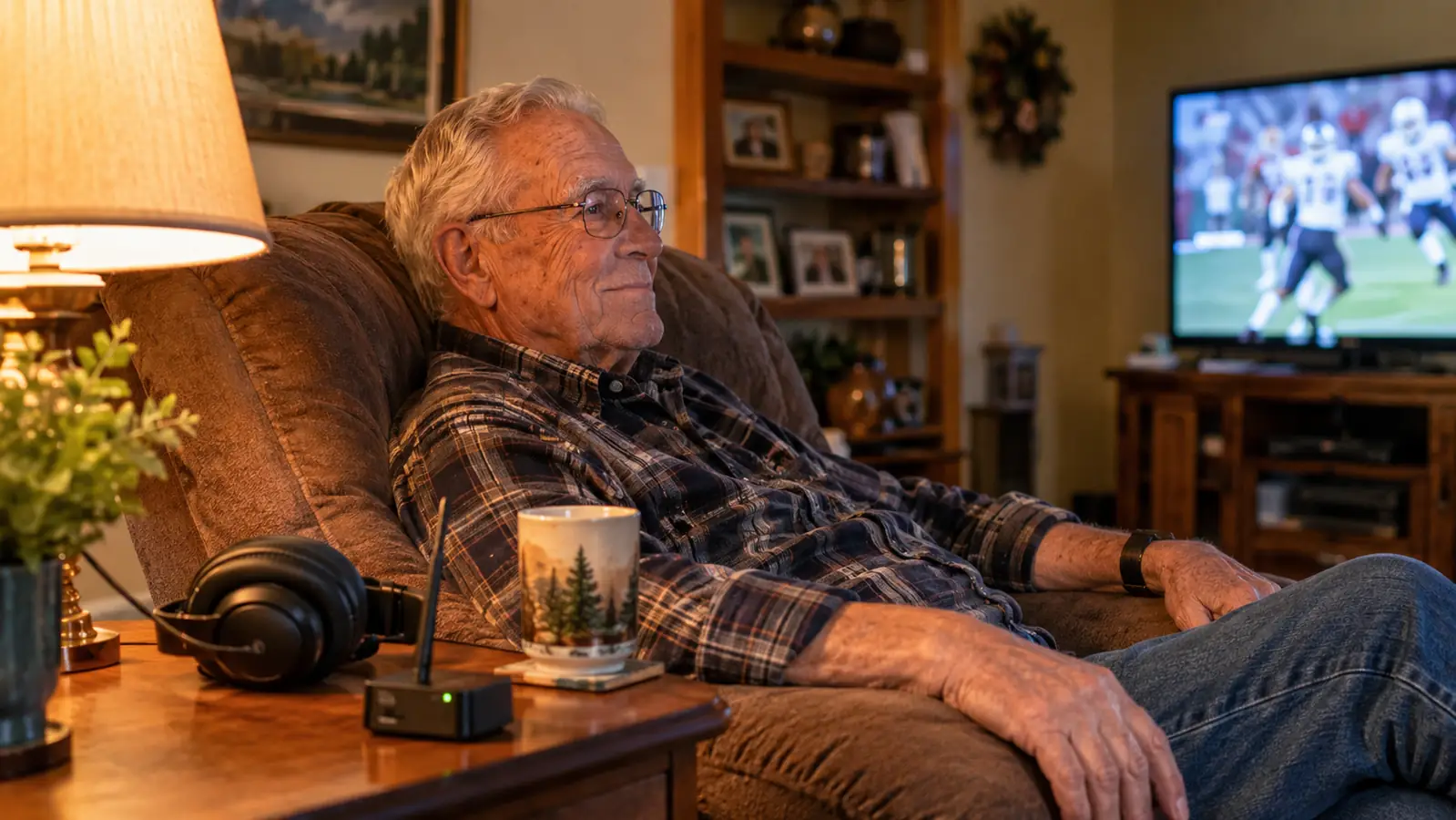
Then there is the television itself. The unit comes with a plug-in microphone and a 12-ft cord. You plug the microphone into the top of the box, run the cord across the floor to the set, and the sound now comes off the television instead of off the whole room. That is a different job than amplifying a room, and it is the reason this thing lives on my recliner arm instead of in a drawer. The 55-inch set sits about 11 feet from my chair. Eleven feet is the number that matters, because a 12-ft cord leaves about a foot of slack in a straight line, and that is not as much as it sounds once you go around the end of the coffee table. I ran mine along the baseboard and taped it down so Carol would not catch a toe on it. The first night with the microphone on the set I watched the six o'clock news, then the weather, then a show I do not even like, just because I could hear it. With the cord in place I watch the evening news at a volume Carol can share the room with. That alone was worth the trouble.
Two AAA batteries run it, and the listing says up to 200 hours. I have not timed it with a stopwatch, but I keep a rough mark on the calendar and it works out to about a season of evenings, a little more if I skip a night. I change the cells when the red light starts looking tired. I buy them by the card at the hardware store in town, the same place I bought job-site batteries for 38 years, so that is one errand I do not mind. The maker is Williams AV out of Minnesota, a name I knew from church sound systems long before I knew they made anything for a living room.
Where the SuperEar SE5000 Wins
The SE5000 is the one I would hand to somebody who is nervous about the whole idea. There is one control, a thumbwheel, and you roll it until things sound right. No tone knob to reason about, no second decision to make. A neighbor brought her mother over to my kitchen table one afternoon and tried both units. She had the SE5000 working before I finished explaining the Pocketalker. For a person who does not want to think about a device, that counts for a lot.
It also disappears. I put it in my shirt pocket, walked into the diner out on the highway, and had a conversation with a man about a truck he was rebuilding. Nobody looked at me twice. That is not nothing, because a device you are willing to wear is worth more than a better device you leave in a drawer. What it did not do was solve my television. The microphone picks up the room, so the set has to be loud enough for the room before the SE5000 has anything to work with. Carol was still leaving. For me that was the deciding factor. Fair is fair, though: the SE5000 did fine at the counter when the girl asked me what I wanted on my burger, and that is a real thing that happens three times a week. The Pocketalker on a lanyard is more machine than that job needs.
The Television Test
I ran the same evening on both units for a week each: the news, a ball game, and a movie with music under the talking. The news is easy. One person at a desk, no music, and either device handles it. The ball game is harder because the crowd noise arrives with the announcer and does not separate. I tried riding the volume during the innings and backing it off for the booth, and gave that up after one night because I kept missing the pitch while my hand was on the button. The movie is the hard one, and it is the one that matters most in my house, because that is what Carol and I watch after supper.
With the room microphone, the crowd noise and the music get amplified right along with the voices. I turned the thumbwheel up and got more of everything, which is the same problem I had before, just closer to my head. With the cord run to the set, the audio arrives clean and the tone knob shaves off the boom. Suddenly the music sits under the dialogue where it belongs instead of on top of it. I have watched a good many movies twice and understood them once. This was the first time in years I caught the whole of one. The test case was a Western we had on a Sunday in March, the kind with a long quiet stretch, then a horse and a guitar, then somebody talking low in a doorway. With the room microphone I got the guitar fine and lost the doorway. With the cord run to the set I got both, and I did not have to ask Carol what was said once. She noticed that too.
Here is the plain version. If one person watches television while another reads in the same room, the cord is the difference between sharing a room and taking turns using it. For a while Carol and I took turns. Now we do not.

What Comes in the Box
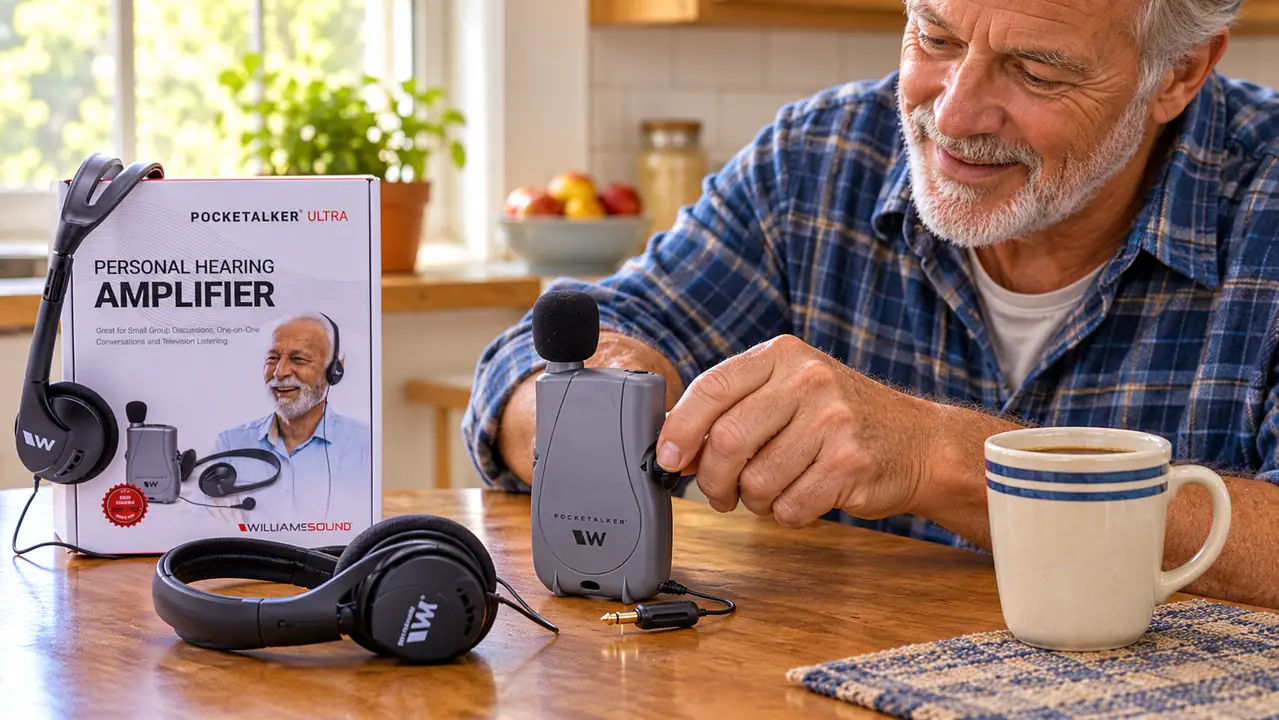
The box lists folding headphones, a mini earbud, the plug-in microphone, a 12-ft television cord, a lanyard and a clip. In practice I use the folding headphones at the recliner and the earbud when I am up and moving, because the earbud sits in one ear and leaves the other open to the house. The headphones fold flat and go in the end-table drawer when the evening is over, which is a smaller thing than it sounds until you have owned something with a cord on it that does not fold. The lanyard hangs the unit around your neck. The clip grabs a shirt pocket. Between the two you can carry it while you make coffee, which sounds like a small thing until you are standing at the counter trying to hear Carol from the other room.
It runs on two AAA cells. The battery note on the listing is not perfectly consistent about whether they come in the box, so buy a pack and be done with it. There is a red light on the unit that tells you it is on, and when that light starts looking weak I swap the cells before it quits in the middle of something worth hearing.
What Neither One Fixes
Neither device sorts out a noisy room. In a booth at the diner with four people talking at once, both units amplify the clatter along with the voices and I end up reading lips anyway. The church hall after service is the same story, and worse, because there is a tile floor, a hundred people and a coffee urn. I tried the SE5000 there on a Sunday and had it off inside two minutes. A personal amplifier turns up whatever the microphone hears, and in a loud room that is mostly not the person you want to hear. If that is your main problem, neither of these is the answer, and I would rather tell you than take your money.
Neither one is a telephone device either. When the grandkids call, I put the phone on speaker and turn the volume up, and on the video calls I turn on captions and read along. That is not a knock on either unit. It is simply the wrong tool for that job. The right tool is a hearing test and a conversation with somebody who fits hearing aids for a living.
The tone knob did more for the evening news than six clicks of the volume button ever did.
The One That Stayed Plugged Into My Television
Two large knobs, a 12-ft cord and a set of folding headphones. If your evenings look like mine, start here.
Amazon Check Today's Price on Amazon →Who Should Buy Which
Buy the Williams AV Pocketalker Ultra if the television is your daily problem, if you watch with somebody who has normal hearing, and if you are willing to spend one evening learning what the tone knob does. Buy it if you sit in the same chair every night and want the thing within arm's reach. The 12-ft cord is the whole argument. It moves the microphone from the middle of the room to the front of the set, and that is what makes the dialogue come out ahead of the music. I will add one thing: give it a week. The first night I had the tone knob in the wrong place and the cord running across the middle of the floor, and I was ready to box it up. By the fourth night the cord was along the baseboard and the knob was where it belongs, and I stopped thinking about it. A device you stop thinking about is a device that is working.
Buy the SuperEar SE5000 if you mostly need help with one person at a time and you want something in a shirt pocket. It is simpler, it is smaller, and it disappears. I did not link it here because I borrowed mine rather than bought it, and I would rather point you at the unit I have lived with for months than the one I borrowed for three weeks. Either way, get your hearing checked first. That is the part I would say twice if I could.
Two Knobs, One Cord, and the End of the Volume Wars
The unit on my recliner. Folding headphones and a mini earbud in the box. Five years on parts and labor per the listing, and batteries you can buy in town.
Amazon See the Pocketalker Ultra on Amazon →