
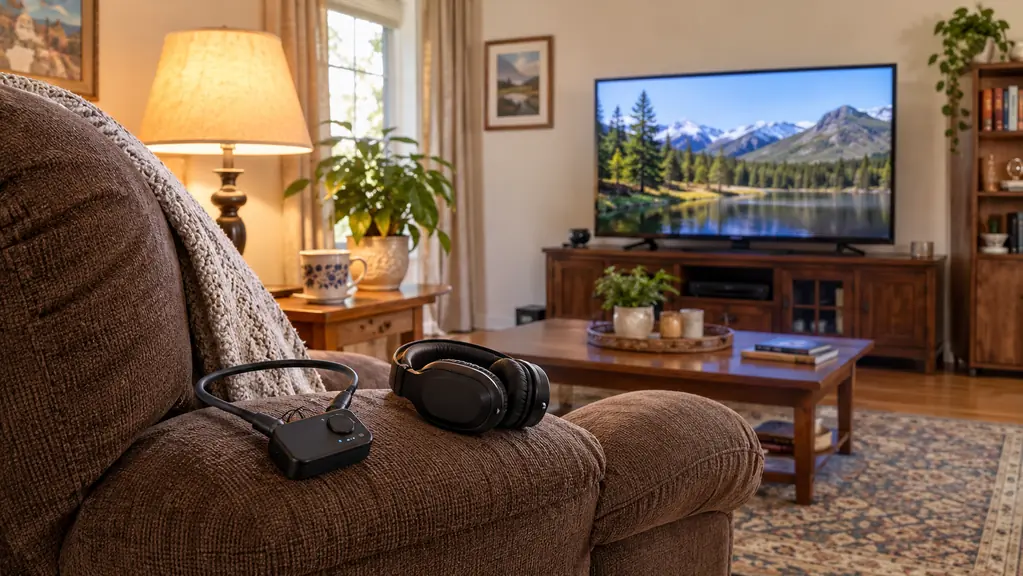
The first time Carol got up and left the living room in the middle of the evening news, I let it go. The second time, she said it out loud. The television was too loud, and it had been too loud for a while. I am 71, I spent 38 years on job sites as an electrician, and at 66 an audiologist in Rolla told me what I already suspected: mild to moderate high-frequency hearing loss in both ears, worse on the left. Consonants are the first thing to go. Then women's and children's voices. Television dialogue buried under music is the daily problem, and it was costing me my evenings with my wife.
The Williams AV Pocketalker Ultra is the third thing I tried. The first was turning the volume up, which works for nobody who lives with you. The second was a cheap personal amplifier I bought without reading anything about it, and it made everything louder in a flat, hissy way that wore me out in ten minutes. The Pocketalker Ultra is a different animal. It is a small neck-worn box made by Williams AV of Minnesota, and it does exactly two things with the sound it picks up: one knob sets the volume, the other sets the tone. That is the whole interface. No app, no pairing, no menu, no programming. I have used it daily for months now, mostly at home, and this is what I found.
The Quick Verdict
Not a hearing aid and not pretending to be. For the television, the kitchen table and one-on-one conversation at home, the Pocketalker Ultra is the most useful thing I have bought in years. It falls apart in noisy rooms, and it will not fix a table full of people.
Amazon Check Today's Price →The two-knob amplifier that got Carol back on the couch
Volume on one knob, tone on the other, no app in sight. Folding headphones, a mini earbud, a plug-in microphone and a 12-ft TV cord are all in the box, with a 5-year warranty on parts and labor.
Amazon Check Today's Price on Amazon →How I've Used It
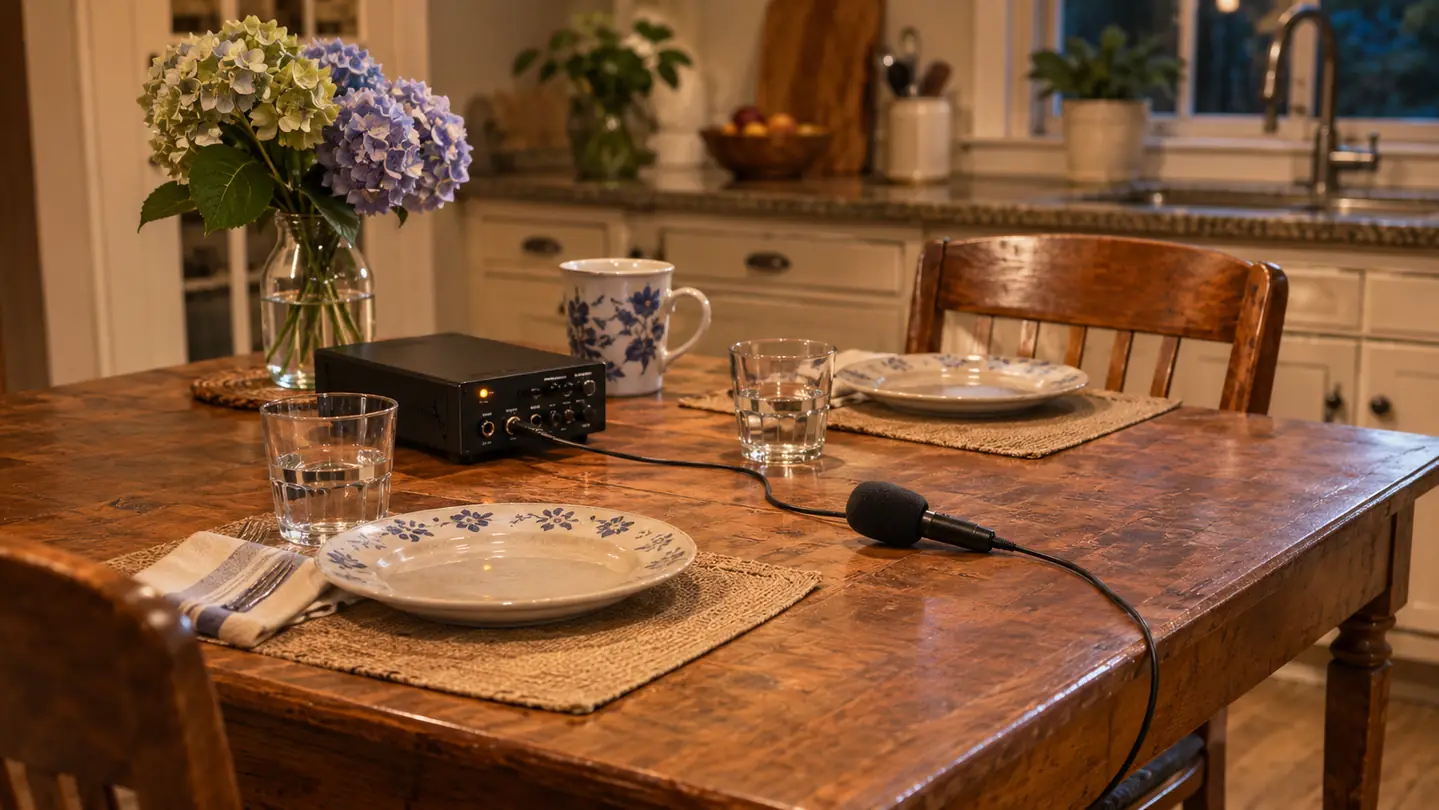
For the last several months the Pocketalker Ultra has lived on the arm of my recliner. I use it most evenings for the news and for ball games. I use it at the kitchen table when Carol and I eat, because that room has a hard floor and a hard ceiling and every plate and fork clatters. I have taken it to church and clipped it to my belt. I have used it on phone calls with the grandkids, with the plug-in microphone set on the table beside the phone. I have used it in the truck exactly once, and I will get to that.
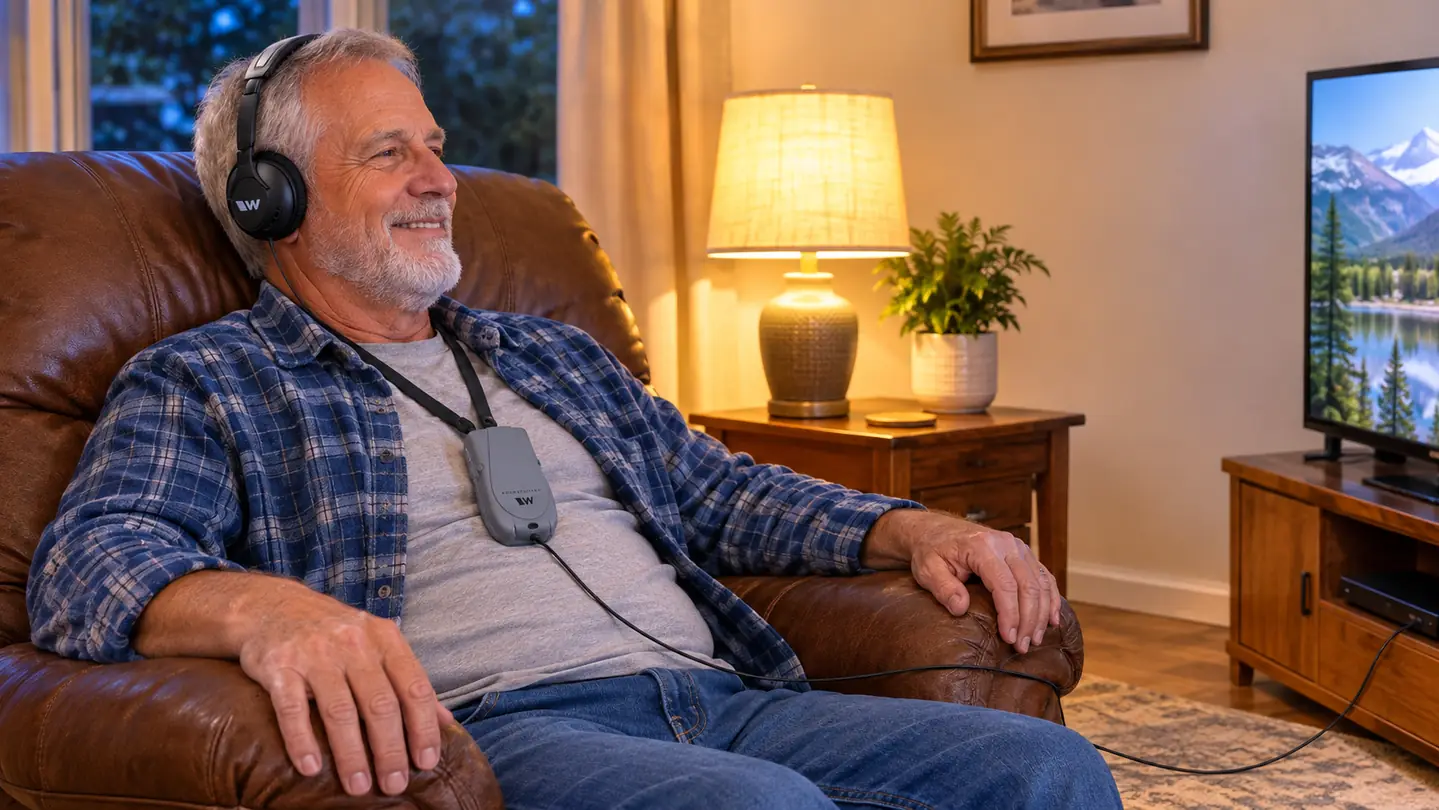
The nightly routine is simple. The long cord runs from the box to the back of the 55-inch set in the living room, which sits about 11 feet from my recliner. I put on the folding headphones. I turn the volume knob until voices sit on top of the music instead of underneath it, and I turn the tone knob until the hiss on the letter S stops being sharp. Then I turn the television's own volume down to where Carol likes it, which is roughly half of where I had it before. That last part matters more than any line on the spec sheet. The television is quiet in the room and loud in my ears, and nobody has to compromise.
The catch is the cord. Twelve feet is generous for one recliner and one set, and it is not generous if you get up for a glass of water or if the dog needs out. I learned to pause things. The box also comes with a lanyard and a clip, so I wear it around my neck at home and clip it to my belt when I am out, but the cord still ties me to the chair. If you want to walk around the house while you listen, this is not that product. That is the single biggest thing I would want a buyer to understand before ordering.
What the Two Knobs Actually Do
One knob is volume. The other is tone. That is not me simplifying it, that is the entire control panel. The tone knob is the one nobody expects and the one I use most. Turned one way it brings up the low end, which helps if voices sound thin to you. Turned the other way it cuts the boom, which is what I do during ball games, because crowd noise and stadium music will swallow a play-by-play call otherwise. A red LED on the front tells you it is on. If that light is not lit, nothing else matters, and I have caught myself twice with a dead battery and a quiet house.
The listing gives a frequency range of 20 Hz to 20 kHz with automatic gain control. In electrician to English, that means two things. The range means it can pass the low rumble of a furnace and the high tick of a fork on a plate, not just the middle band where voices live. The automatic gain control means it pulls the loud stuff down instead of letting it spike. That is the real difference between this and the cheap amplifier I threw away. On that one, a door slam or a laugh hit me like a slap, I flinched, and I pulled the earbud out. On the Pocketalker Ultra a loud noise gets compressed, so I stay in the conversation instead of reacting to it.
Williams AV rates the audio sensitivity at 110 dB, which is plenty for my loss. I run the volume knob at maybe a third of its travel most nights. That headroom is worth having. Carol's hearing is normal and she noticed the difference before I did, so I will say it plainly: I am not maxing this thing out. If your loss is more severe than mine, that headroom is one more reason to have a real hearing test before you spend anything, because no amplifier on a cord is a substitute for a properly fitted hearing aid.
The television is quiet in the room and loud in my ears, and nobody has to compromise.
Headphones, Earbud, and Which One I Actually Wear
The box comes with folding headphones and a mini earbud, and I use the headphones about 90 percent of the time. The earbud is fine for a short phone call, and it is what stays in the case for church. Headphones over both ears give me more of the room and less of a fight. The earbud in one ear leaves my other ear open, which sounds like a sensible idea until the furnace kicks on. If your loss is worse on one side, as mine is, the earbud in that ear and the headphones the rest of the time is a reasonable split. Williams AV includes both, so you can find out which you are without ordering a second thing.
The plug-in microphone is the piece I did not expect to use, and it has earned its spot. You set it near whatever you want to hear, and it picks up sound closer to the source than the box hanging on your neck can. I use it at the kitchen table when the four of us are talking over plates. I use it beside the phone when a grandchild calls, because a phone speaker at arm's length is exactly the kind of thin, quiet source my ears are worst at. It is a small thing on a short cable, and it does more work than its size suggests.
At church I clip the box to my belt, run the earbud up under my shirt collar, and set the plug-in microphone on the pew in front of me when the sound system is struggling. That is not what the product was designed for, and it works anyway. It also gets me a look from the usher, which I have decided to survive.
Battery Life, and the Small Annoyances
It runs on two AAA batteries, and Williams AV puts the runtime at up to 200 hours. I have not timed it with a stopwatch, but I changed batteries about once every six or seven weeks running it an hour or two a night, and that tracks with the number on the box. Two things about that. Keep spares in the case, because the failure is silent and sudden. And these are ordinary AAA batteries, not a built-in cell you recharge, so you are never hunting for a cable and never waiting on a charge to finish. Some people will call that old-fashioned. I call it one less thing to think about.
The annoyances are real but small. The knobs move easily with a thumb, which means they also move by accident when the box swings on the lanyard, and I have nudged the tone knob more than once reaching for a coaster. The plastic body is light and has survived a drop onto a hardwood floor without complaint, but it does not feel like a piece of equipment that wants to live in a toolbox. There is no display, so the red LED is your only status, and it tells you on or off and nothing else.
One more thing worth saying. Williams AV puts a 5-year warranty on parts and labor, with 90 days on the accessories. That is not a normal promise for a small battery-powered box, and it is a large part of why I stopped shopping once I read it. I have not had to use the warranty. I am not worried about the box. I am mildly worried about the headphones, which are the accessory and the part most likely to get sat on.
Where It Doesn't Help Much
A restaurant is where this falls apart, and I want to be straight about it. The Pocketalker Ultra amplifies what the microphone hears. In a room with forty other conversations, a dishwasher and a speaker in the ceiling, that is a wall of noise turned up. It does not sort voices out of a room. Nothing in this category does, and some of the marketing on the others implies otherwise. Same story in the truck at highway speed, where road noise comes in with everything else. I tried it once and put it away.
It also will not do anything about the hardest part of my loss, which is a woman or a child talking to me from another room with the water running. An amplifier is not directional and it is not smart. If you expect it to follow a conversation across a noisy house, you will be disappointed, and that disappointment will not be the product's fault. It is a microphone, two knobs and a pair of headphones, and it is very good at being exactly that.
What I Liked
- The tone knob does what no volume knob can: it separates voices from music and crowd boom
- Runs all evening on two AAA batteries, up to 200 hours by the listing, with no charging cable to lose
- Folding headphones, a mini earbud, a plug-in microphone and a 12-ft TV cord all come in the box
- 5-year warranty on parts and labor from Williams AV, which is unusual for a box this size
- Automatic gain control keeps a door slam or a laugh from jolting you out of the earbud
Where It Falls Short
- The 12-ft TV cord ties you to one chair, so you cannot walk the house while you listen
- No display and no saved settings, just two knobs and a red LED, so an accidental nudge changes everything
- In restaurants, crowds and wind it amplifies the room rather than the person across from you
- The headphones are the flimsiest part of the kit and carry the shortest warranty
Who This Is For
If your problem is the television, this is the product I would hand you. Same if your problem is one person across a kitchen table, or a phone call you keep missing words in, or a pew on Sunday morning. It suits people who want to put something on, turn two knobs until it sounds right, and never think about it again. It suits people who do not want another app on a phone they barely tolerate. And it suits a household where one person's volume is ruining the other person's evening, which is the exact situation I was in.
Who Should Skip It
Skip it if you need to hear in restaurants, in a car, or in a room full of grandchildren all talking at once. That is a different problem and it needs a different answer, usually a properly fitted hearing aid from an audiologist. Skip it if you want sound in your ears while you walk around the house, because the cord will stop you. And skip it if you have not had a hearing test. I am not a doctor and I will not pretend to be one. I was tested at 66, I know what my loss looks like on paper, and that is exactly why I can tell you this amplifier is a good fit for me. Get the test first. Then buy the box.
Months in, the Pocketalker Ultra has earned its spot on the arm of my recliner. It is not a clever product. It has two knobs, a red light and a cord, and it wants nothing from you but batteries now and then. What it gave back was the evening news with my wife in the same room. I did not know how much I had missed that until I had it again.
Two knobs, one cord, and the television volume back where Carol wants it
If your evenings look like mine did, this is the simplest thing I have found that fixes them. Check today's price and read the listing for yourself.
Amazon Check Today's Price on Amazon →