
I have mild to moderate hearing loss in both ears, worse on the left, and I earned it the old-fashioned way: 38 years of job-site noise and not a single earplug until it was too late. The audiologist who tested me at 66 told me what I already suspected. What I did not expect was how much of my day would come down to one question. Can I hear the phone? A landline handset pressed to a bad ear is the hardest listening I do all week. Harder than the television, harder than church. So I bought two amplified cordless phones and lived with both of them. The Panasonic KX-TGM420W is the one still sitting on my side table.
The short answer, before the long one. If the person on the other end talks fast, and you have lost the high frequencies where consonants live, the Panasonic is the easier phone to live with, and it comes down to one button. If what you need is a phone that announces out loud who is calling from across the room, and you would rather not read a manual to get it running, the VTech is the friendlier machine. Neither one is a hearing aid. I am not an audiologist and I am not going to pretend to be one, so get your hearing tested before you buy any phone at all.
| Panasonic KX-TGM420W | VTech Amplified | |
|---|---|---|
| Volume boost | Up to 40 dB on the handset, per Panasonic's own numbers | Also boosts, and in the same neighborhood from what I could hear side by side |
| Fast talkers | Slow Talk button slows the caller's speech in real time | No equivalent button on the model I compared |
| Knowing who is calling | Name on the large screen, plus a 100 dB ringer | Announces callers out loud, which is why a lot of folks buy it |
| Getting it set up | Menu-driven, took me most of an evening | Simpler out of the box, fewer menus to walk through |
| Robocalls | 100-number call block list | Blocks calls too, but the limit is not published anywhere I could find |
| Extra handsets | Expandable to 6 handsets | Not something I checked, so I will not score it |
| Hearing aid compatibility | Rated hearing aid compatible | Rated hearing aid compatible as well |
| Answering machine | Digital, 17 minutes of recording capacity | Built in, capacity not something I measured |
Where the Panasonic Wins
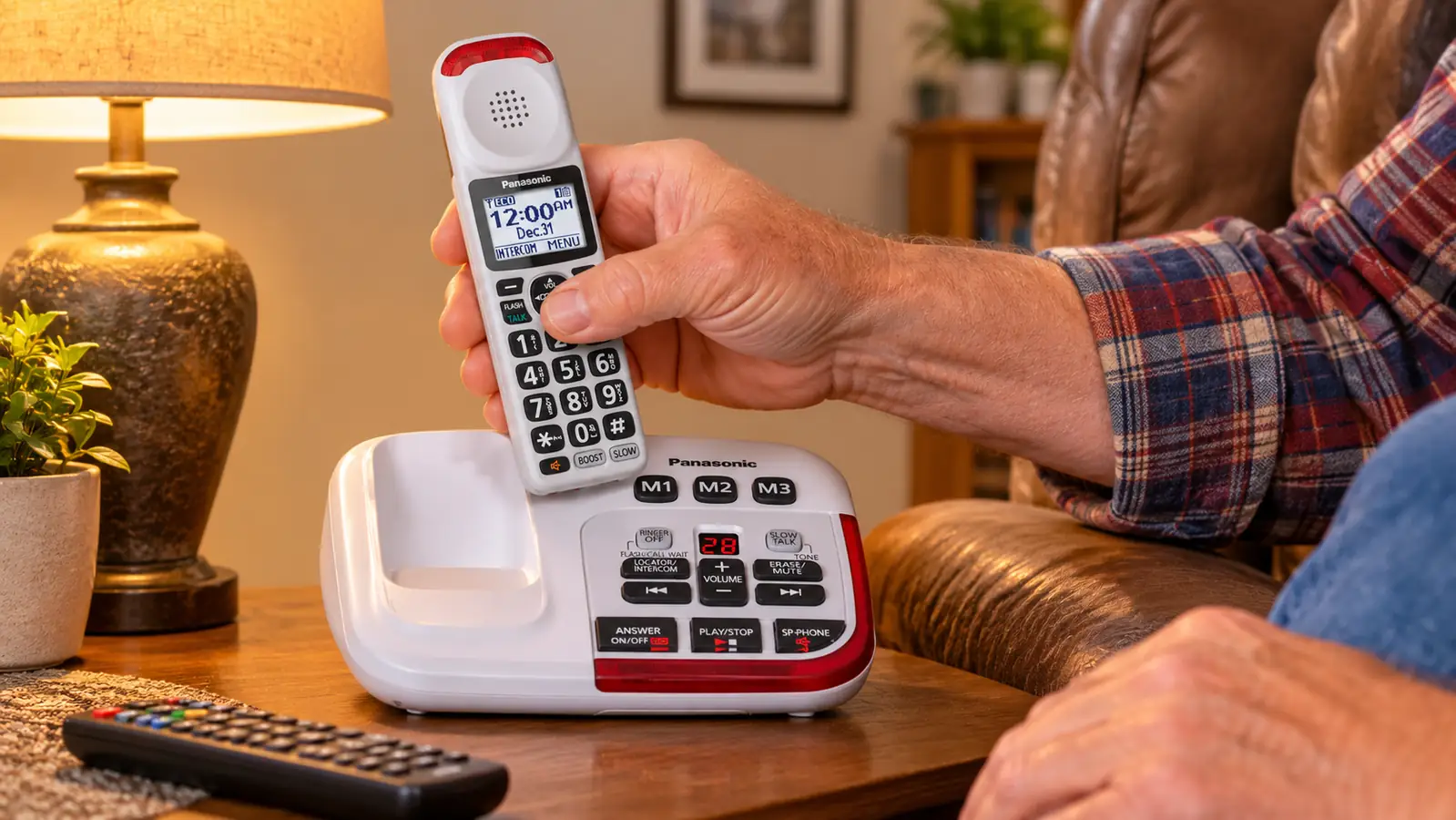
The button I did not know I needed is called Slow Talk. It slows the speed of the caller's speech while you are on the call. That sounds like a small thing on the side of a box and it is not a small thing at my kitchen table. My daughter talks like an auctioneer. My insurance agent talks like an auctioneer with a timer running. I press that button and the words separate out, and I stop guessing at the ends of sentences. With high-frequency loss the consonants go first, and fast speech is what turns a sentence into a mush of vowels. Slowing it down does more for me than raw loudness ever did.
Volume is here too, up to 40 dB of boost on the handset by Panasonic's numbers, and the ringer is rated at 100 dB. I keep the ringer at about half and it still carries from the kitchen to the recliner. The rest of what I actually use: a 100-number call block list that has stayed nearly full since the second week, nine speed dial entries for the four grandkids, Carol's cell, our son, the pharmacy, the church office and my brother, and a backlit keypad I can read without turning on a lamp. The display is large enough that I am not squinting at it. It is expandable to six handsets, though one is all my house has ever needed.
Where the VTech Wins
The VTech does one thing better and I am not going to talk around it. It announces the caller out loud. When the phone rings in the kitchen and I am eleven feet away in the recliner, the VTech tells me who it is before I get up. That is a real convenience, and it is the reason a lot of people buy that brand in the first place. If your problem is missing calls rather than understanding them, that feature earns its keep every single day, and no amount of boost on the other phone replaces it.
It is also the easier phone to get running. I had the VTech taking calls in about ten minutes. The Panasonic took me most of an evening of walking through menus to set the ringer volume, the date and time, and the answering system the way I wanted them. I am a retired electrician and a menu does not scare me, but I am not going to tell you it was quick. My brother-in-law has the VTech now and he is happy with it, and his hearing is worse than mine.
Slowing a caller down is worth more to me than raw volume, and I did not learn that from a spec sheet.
If fast talkers are the problem, this is the button that fixes it
The Panasonic KX-TGM420W puts Slow Talk on the handset, alongside up to 40 dB of boost and a 100 dB ringer. It is the one still sitting on my side table after both had a turn.
Amazon Check Today's Price on Amazon →What Neither Phone Fixes
Neither of these phones is a hearing aid and neither one will give you back the frequencies you have lost. I want to be plain about that, because the printing on both boxes is cheerful in a way that can mislead a person who is already frustrated. An amplified phone makes the sound louder and, in the Panasonic's case, slower. It does not make your ear better. If you have not had a hearing test in years, go get one. Mine took about forty minutes, and it told me exactly which ear was worse and by how much, and that one piece of knowledge changed how I hold a telephone.
I hold the handset to my right ear now, every time, because the left is the worse one and I wasted a good year not knowing that. Small thing. Also free. A phone that boosts 40 dB into your bad ear is still boosting into your bad ear, and no feature on any handset makes up for pointing it at the wrong side of your head. The audiologist put it plainly enough that I remember it: the chart had a slope on the left side that looked like a roofline, and she said that slope is where the consonants live. Nobody sells a phone that puts that back.
Two Weeks of Real Calls
Here is what the phones actually did around here. The grandkids call on Sunday afternoons and they talk over each other, which is what grandkids do. With Slow Talk on I can follow the whole thing, and I do not have to ask them to repeat themselves twice in the same call. That matters more than it sounds like it should. Asking a nine-year-old to repeat himself once is fine. Asking him four times is how you end up with shorter phone calls every month and nobody saying why. The youngest one, who is six, holds the phone right up against his mouth so it comes through like a CB radio. Slow Talk does not fix that. Nothing fixes that. You laugh and you ask him to hold it away from his face.
Carol and I use the speakerphone at the kitchen counter when the pharmacy calls about a prescription, and the sound carries well enough that we can both stand there and follow it. Weather, church, the bank, and the fellow who wants to sell me an extended warranty on a truck I sold in 2019. That last one goes on the call block list. Blocking a number is the most satisfying thing this phone does and it is the feature I expected to care about least. I have blocked the same outfit under four different numbers now, which tells you something about the outfit.
Battery has not been a worry. Panasonic rates it at 13 hours of talk time and about 9 days of standby, and the two AAA batteries come in the box. I set it back on the base out of habit and it has never died mid-sentence. The whole unit weighs around 1.1 pounds, so it is not going to drag a side table over. The one time I tested the claim I left it off the base on purpose, on a Thursday, and it was still taking calls Saturday morning.

The Setup Nobody Warns You About
Put the base where you sit, not where the old phone jack made sense thirty years ago. Mine lives on the side table next to the recliner, and it moved there after two days of getting up to answer. It is cordless and the range is fine for a one-story ranch house, but a phone clear across the room is a phone you will let ring. Before that I had it on the kitchen wall, where the old one hung, and I made the walk four times in one evening before I gave up and moved it. Eleven feet, roughly, from recliner to side table. That is about as far as I want to reach.
Second thing: set the ringer volume before you decide the phone is too quiet. Mine came out of the box set lower than I wanted, and I spent an hour thinking the ringer was weak before I found the menu that fixes it. It is rated at 100 dB and it will get loud enough to bring you out of the chair. Third thing: fill in the speed dial list in the first week, before you forget, because a phone that makes you remember ten digits is a phone you will use less. I did mine on a Monday morning with the manual open on the counter and a pencil, and I have not touched that menu since.
The Answering Machine and the Small Stuff
The answering system on the Panasonic is digital and holds 17 minutes of messages, which is more than I will ever need and less than my sister manages in a weekend. I use it mostly when I am out in the yard. I can see the message count on the screen when I come back in, and I do not have to walk to a separate machine to find out whether anybody called. That is the whole value of it for me, and I suspect it is the whole value for most people. The old tape machine in the hall closet is still there. I have not plugged it in since March.
It is a three-way conference capable handset and it works with a headset, both of which I have used exactly once and neither of which changed my life. It runs on DECT 6.0, which is the ordinary cordless standard rather than a selling point worth building a decision around. What I would pay attention to instead is the number of speed dial slots, the size of the screen, and whether the boost and the Slow Talk control are reachable with a thumb without looking down. On the Panasonic, all three are. I checked the last one in the dark during a ball game, which is the only honest way to test it.
Who Should Buy Which
Buy the Panasonic if the hard part of a phone call is understanding the words. Fast talkers, heavy accents, family members who call from a noisy kitchen with a dog barking behind them. Buy it if you want the Slow Talk button, the call block list, and a screen big enough to read a name without hunting for your glasses. Buy it if you are willing to spend one evening in the menus and then never think about the setup again. That is the trade, and it is a fair one.
Buy the VTech if the hard part is knowing the phone rang at all. If you are not getting out of that chair unless you are sure it is one of your people, the talking caller ID is worth more to you than anything the Panasonic does, and I would not argue with you for a minute. Buy it if you want to plug it in and be finished. And if you truly cannot tell the two apart on a quiet call, pick the one that annoys you least and get on with your day.
One button that ends the guessing on fast talkers
Up to 40 dB of boost, Slow Talk on the handset, a 100 dB ringer and a 100-number call block list. It is not a hearing aid and it does not pretend to be. It is a phone I can use.
Amazon Check Today's Price on Amazon →