

The phone rang on a Tuesday evening in March and I let it go to the machine. It was my granddaughter. I knew how that call would go, because we had run the same script a dozen times. She would say something, I would ask her to repeat it, she would repeat it louder, and after four minutes we would both be worn out and she would find a reason to hang up. I have mild to moderate high-frequency hearing loss in both ears, worse on the left, from 38 years around job-site noise. Consonants go first. Women's and children's voices go right after them. So when Carol finally pushed me to do something about the house phone, I bought the Panasonic KX-TGM420W, put it on the table by my recliner, and used it every day for months before I sat down to write this.
Here is the short version before the long one. It works, and it is not a hearing aid, and nobody should buy it expecting one to come out of the box. What it gives you is a house phone that can push more volume into your ear than a standard one, a button that slows the person on the other end so your brain can keep up, and a ringer loud enough to find you in the garage with the door down. That middle part, the slowing down, is the piece I did not expect to care about and now lean on almost every call.
The Quick Verdict
A loud, simple house phone that does what the box says. Slow Talk earns its spot on the keypad. The ringer is closer to a fire alarm than a doorbell, and the battery cover on the handset feels flimsier than the rest of the phone.
Amazon Check Today's Price →The phone that lets you hear the call the first time
The Panasonic KX-TGM420W puts up to 40 dB of volume boost and a Slow Talk button on a plain cordless handset. No app, no account, no pairing. Plug it in and answer it.
Amazon Check Today's Price on Amazon →How I've Used It
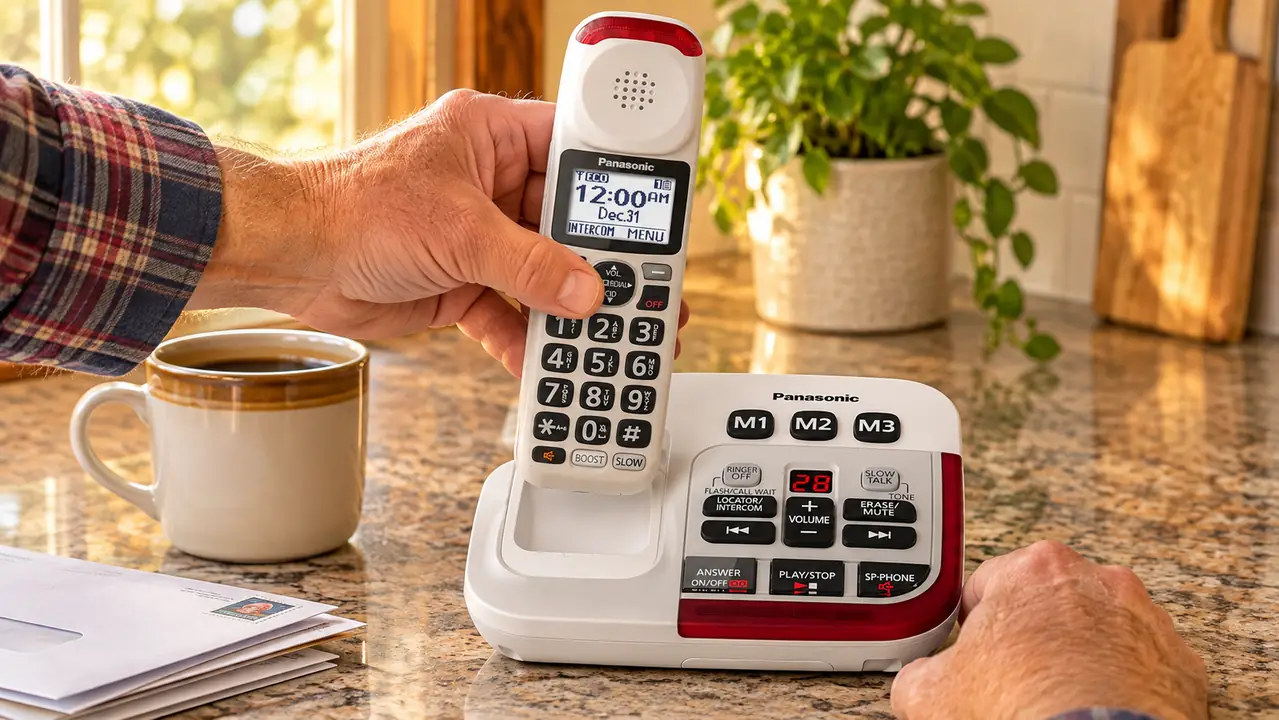
The Panasonic base sits on the side table next to my recliner, about 11 feet from the TV, and that is where it has lived since the day it arrived. Setup took about four minutes. I plugged the base into the wall jack, dropped the handset on it, and let it charge. There is no account to create and nothing to pair with anything else in the house. It is a DECT 6.0 cordless phone, one base and one handset, no antenna to fiddle with. I have spent whole Saturdays getting a printer to talk to a laptop, so I notice when a thing just works.
Before this I had a standard cordless phone, the kind that comes in a two-pack, and it was fine for Carol and useless for me. I also tried a cheaper amplified phone first, bought it at a big box store over in Jefferson City on a Saturday and took it back the following week. The volume went up, all right, but it went up in a way that made voices sound like they were coming through a paper towel tube, and there was no way to slow anybody down. That returned phone is the reason I read the Panasonic listing through twice before I ordered it.
Most of my calls are landline calls. Family, the pharmacy, the church office, the insurance office, and my brother in Springfield, who talks like he is being paid by the word. Carol and I both use it, and she has normal hearing. She picked it up on her own mainly because she can hear it ring from the kitchen, which was half the argument in this house to begin with.
One thing to get straight up front. I am not an audiologist and I am not a doctor. I am a retired electrician with a hearing test on file from 2016, and everything below is one man's experience with one phone in one house. If you have not had your hearing checked, do that first. A louder phone is not a substitute for knowing what is going on with your ears.
The 40 dB Boost, in Plain Terms
The listing says up to 40 dB of volume boost. Decibels are a scale, not a bucket of loudness, and roughly speaking an increase of ten decibels is about twice as loud to the human ear. So 40 is not a marketing rounding. It is a real number and it does real work. In practical terms, on a normal house phone my granddaughter's voice sat right at the edge of what I could follow. With the boost up, she sits comfortably inside it, and I am not filling in the blanks from context anymore.
I checked it the only way I know how, which was with a decibel app on Carol's tablet held up next to the earpiece, and I will tell you right now that is not lab equipment. What it told me was what my ears already knew. At the setting I use for the grandkids, the earpiece is running somewhere in the neighborhood of 20 decibels above where the old handset sat. That is roughly four times louder to the ear, and it is the difference between following a call and guessing at one. An electrician notices a gap like that.
I do not run it wide open. Most calls I keep it around two thirds and go higher for the grandkids and for anyone with a soft voice. Past about three quarters, the volume climbs faster than the clarity does. It gets loud before it gets crisp. That is an honest trade on any amplified phone, and if somebody tells you their unit is perfectly clean at full boost, ask them what they were listening to.
My left ear has a hearing aid in it. The handset is rated hearing aid compatible, and with the aid in that ear I can hold it the normal way, against the ear, without angling it or holding it an inch off my head. I have used phones where that little dance was the entire conversation. This is not one of them.
Slow Talk Is the Button I Use Most
There is a button on the handset marked Slow Talk. Press it and the speech of the person you are talking to slows down, in real time, while the call keeps going. You do not have to tell them you are doing it and you do not have to ask them to repeat. That is the whole idea, and it took me about two calls to understand why it matters more than raw volume.
My brother in Springfield is the reason. He is 68, he talks fast, and he drops the ends of his sentences the way people do when they have told a story a hundred times. On a normal phone I catch the setup and lose the punchline. With Slow Talk on I get the whole thing. Same with the woman who runs the church office reading off a schedule, where every number sounds like every other number. Slowing her down pulls them apart.
The pharmacy is the other good example, and it is the one that sold me. Their refill line reads back a confirmation number, and before this phone I would write down three digits, guess at the other four, and call back to start over. Now I press Slow Talk the second the recording starts and I get the whole number on the first pass. Same recording, same phone line, just at a speed my ears can work with. The first time it happened I sat there a second feeling foolish about all the years I spent guessing.
The trade is that everything slows, including the pauses, so a fast talker ends up sounding a little stretched out. It is not something you leave on for a whole conversation with someone who already speaks slowly. I turn it on and off mid-call, which is a two-second thing once your thumb learns where the button sits.
On a normal phone I catch the setup and lose the punchline. With Slow Talk on I get the whole thing, and I am not asking my brother to repeat himself twice a call.
A Ringer You Can Hear From the Garage, and a Call Block That Earns Its Keep
The ringer is rated at 100 decibels and there is a visual alert that goes with it. That is loud. A normal conversation runs somewhere around 60, and a gas mower at the curb is around 90. I can be at the back of the garage with the door down and still hear this thing. On a quiet Sunday afternoon it will bring you out of your chair, which is a fair trade for never missing a call from one of the kids.
The visual alert is the part I did not expect to lean on. It flashes on the handset, so when I am at the kitchen sink with the water running I see a call coming before the machine picks up and I get there in time. Between the sound and the light, this is the first phone in this house that does not quietly lose calls to the answering machine while I am twenty feet away doing something else.
For Carol, the ringer was the part that solved her problem. Her complaint was never that I could not hear the caller. It was that the phone would ring, I would not hear it, and the machine would pick up while she was elbow deep in dishwater. Now she hears it from the kitchen and hollers, and I answer. Two weeks in, that stopped being a joke and became the normal way this house runs.
The call block holds 100 numbers, and I have used maybe 30 of them. Political calls, a warranty outfit that kept calling about a truck I sold in 2019, and a recording that claimed to be from the power company. It takes a few seconds per number and after that they are gone. For a man who used to unplug the phone during dinner, this is a genuine improvement.
Screen, Keypad, Battery, and the Small Annoyances
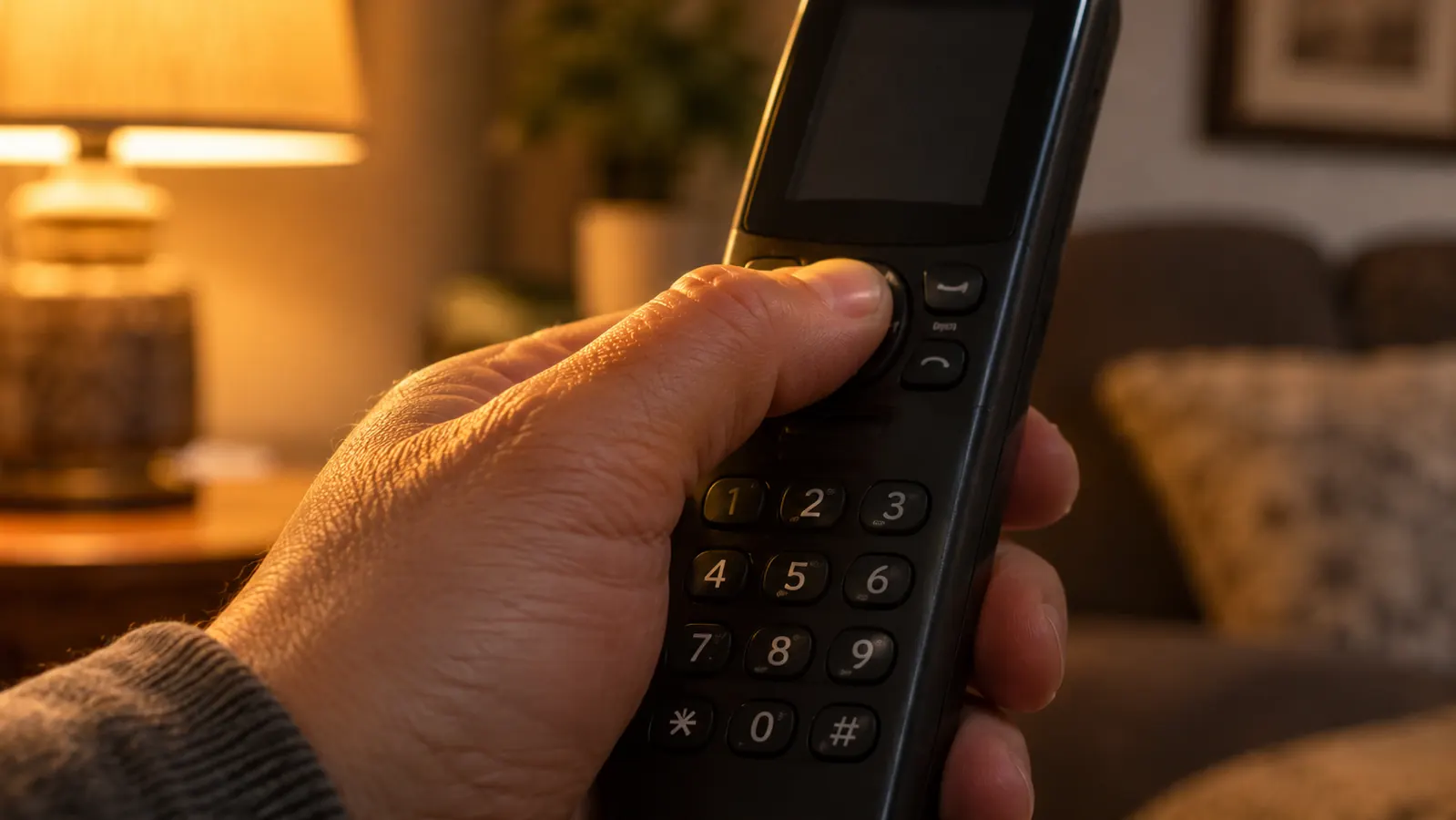
The screen is large and the keypad is backlit, which matters more than the sales copy lets on. My recliner lamp is behind me, so the handset sits in its own shadow after dark. The backlit keys mean I can dial the pharmacy at 9 at night without turning on a light or hunting for my glasses. There are 9 speed dials, and I filled 6 of them in the first week, which should tell you how often I was dialing the same numbers.
Two AAA batteries come in the box and the handset charges on the base. Standby is listed at 9 days and talk time at 13 hours. My record in a single day is a little over two hours, the Sunday our daughter called and then handed the phone around to all four grandkids one at a time, and the handset never came close to running out. I have never come close on an ordinary day either. It sits on the base out of habit, gets picked up for maybe an hour of calls total, and goes back down. When these batteries finally give out, they are standard AAAs you can replace yourself, not a proprietary pack you have to order special.
My one real complaint is the battery cover on the back of the handset. It is thin and it flexes when you press it, and I handle it like it might crack. I noticed it the first night, when I opened it to check what was inside, and I have been careful with it ever since. Everything else on this phone feels solid. That cover does not.
The answering machine holds 17 minutes of messages, which sounds like nothing until you notice most of ours run 20 seconds. The Panasonic will also do a three-way call, and I used that exactly once to get Carol and our daughter on the line together, which worked fine and then turned into an argument about a wedding shower, so I am not eager to repeat it. The system is expandable to six handsets if you have a bigger house and want phones in more rooms. It is listed as compatible with a headset, though I never tried one.
What I Liked
- Slow Talk slows the other person down without you asking them to repeat
- Up to 40 dB of volume boost, and I rarely need it maxed out
- Ringer rated at 100 decibels with a visual alert, audible from the garage with the door down
- Large screen and backlit keypad are readable in a dark room
- 100-number call block that quiets the telemarketers for good
- Hearing aid compatible handset, no awkward holding angle
Where It Falls Short
- Past about three quarters of the way up, volume climbs faster than clarity
- Battery cover on the handset feels thin and flexes under your thumb
- The ringer is loud enough to be startling on a quiet afternoon
- One handset in the box, so a bigger house needs extra handsets
Who This Is For
This is for someone whose hearing test came back with mild to moderate loss and who still wants a phone on a table, not a smartphone they have to look at. It is for the person who has been saying what to every caller and has started letting the machine pick up because the conversation is not worth the effort. It is also for the spouse who has become the translator, which in this house was Carol. The Panasonic is the phone I would hand to a friend in that spot without a long explanation.
Who Should Skip It
Skip it if you need captioning or text on the screen while someone talks, because this is a voice phone and that is all it is. Skip it if your loss is profound. No amount of boost fixes a conversation you cannot hear at all, and that is a conversation to have with an audiologist, not with a cordless phone.
Also skip it if you want one device to do everything. This phone makes calls. It does not text, it does not show you photos, and it does not run anything you would call an app. If the grandkids only reach you by text message, this is not the tool, though it will at least let you hear them on the days they do call.
Months in, it is still the phone on my side table
No app, no pairing, no learning curve. Up to 40 dB of boost, Slow Talk, a ringer rated at 100 decibels, and a 100-number call block. Carol hears it from the kitchen and I hear the call the first time.
Amazon Check Today's Price on Amazon →