

The hardest room in my house is not the living room. It is the kitchen table. From my recliner I can follow the evening news if I lean forward and pay attention. Six feet across a plate of food, with four people talking and the dishwasher running, I lose about a third of what gets said. Carol will tell you I nod at the wrong times. She is right.
I have mild to moderate high-frequency hearing loss in both ears, a little worse on the left, from 38 years around job-site noise. An audiologist in Rolla confirmed it when I was 66. Consonants are what go missing first. The difference between 'pass the salt' and 'past the salt' is not something you can guess your way through. What changed dinner for me was not a grand solution. It was a small amplifier with two knobs on it, the Williams AV Pocketalker Ultra, and about ten minutes of learning where to put the microphone.
Two knobs, one microphone, and a dinner table you can finally follow
The Pocketalker Ultra is a neck-worn amplifier. No app, no pairing, no programming. Plug in the microphone, set the tone, put the earpiece in. That is the whole setup.
Amazon Check Today's Price on Amazon →Here is the part nobody tells you about these devices. The hardware is simple. The results depend almost entirely on where you sit and where the microphone sits. I got it wrong for the first two weeks. Carol got tired of repeating herself and I got tired of asking. Once I fixed the placement, most of the repetition stopped. What follows is the order I do it in now, every time we have people over.
Step 1: Put the Microphone in the Middle of the Table
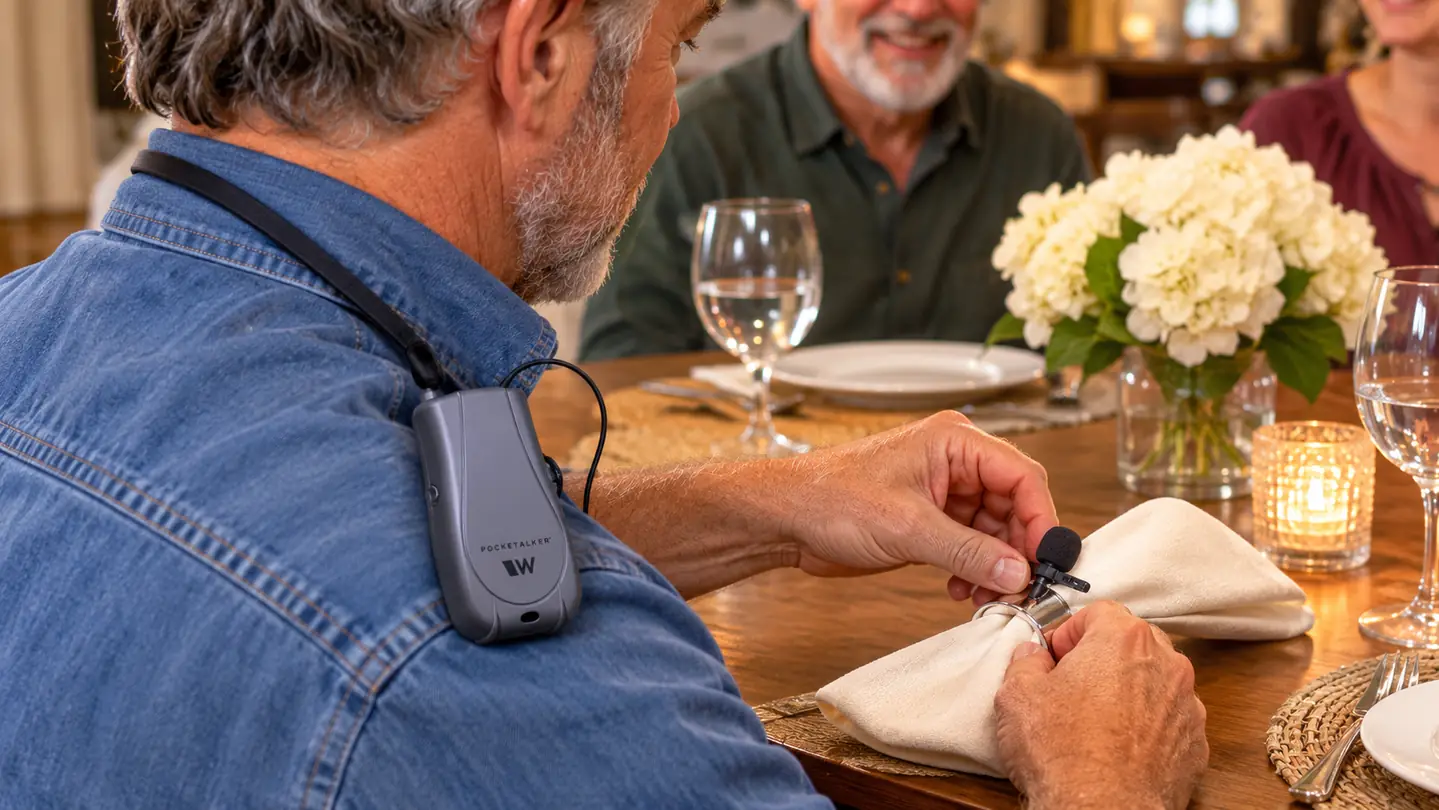
The unit comes with a plug-in microphone on a cord. The instinct is to set it beside your own plate, because you are the one who needs the help. That is the wrong move. The microphone does not know which ear is worse. It picks up whatever is closest to it, and if it is parked by your plate, it picks up your own chewing and the person on your right, and very little of anybody else.
I run the cord down the center of the table, past the butter dish, and clip the microphone to a napkin ring about halfway down. Now it sits at roughly the same distance from everyone. My son at the far end comes through at close to the same level as Carol on my left. That one change did more for me than any knob adjustment I made in two weeks of fiddling.
The first Thanksgiving after I got it is the clearest example I can give you. Eight people at a table meant for six, a turkey platter wedged in sideways, and the microphone sitting by my plate where I had put it out of habit. I heard myself swallow for forty minutes and almost nothing from my daughter-in-law on the other end, who speaks softly to begin with. I moved it mid-meal to the centerpiece and the difference was immediate enough that Carol noticed from across the table. She asked if I had turned it up. I had not touched a knob.
Two things to keep the microphone away from. The dishwasher, if yours is the noisy kind, and the heat register under the window. Both feed a steady wash of sound into the microphone that your ear then has to fight through. Ours is a one-story ranch with the kitchen open to the table, so the dishwasher is right there. When it is running, I move the microphone toward the quiet side of the table and let the tone knob do the rest. It is not perfect. It is a lot better than leaning in and squinting.
Step 2: Set Both Knobs Before Anyone Sits Down
There are two large knobs, one for volume and one for tone. That is the whole control panel. No app, no pairing, no programming, no menu to get lost in. A red LED tells you it is on. I spent my working life around switches and panels, and I still appreciated that I could work this one in a dim room without my glasses.
Volume first. Turn it up until speech is comfortable, then back it off one notch. The mistake I made was setting it where voices were loud but shouty. Loud and clear are not the same setting. The automatic gain control keeps a sudden laugh or a dropped fork from spiking in your ear, but it will not rescue you from a volume knob set too high. Comfortable beats loud every time.
Then the tone knob, which is the one people skip. Move it toward the higher side and the consonants come forward. S, T and K stop blending into each other. Push it too far and everyone sounds thin and hissy, so walk it back until Carol sounds like Carol again. The frequency range on this thing runs the full 20 Hz to 20 kHz, so there is room to find that spot. I marked my setting with a pencil line on the case so I can find it again after the grandkids have been at it. My granddaughter turned it all the way to one end last spring and I spent a whole supper wondering why everyone sounded like they were calling from a tin can. Now the pencil line tells me where home is.
Step 3: Pick the Earpiece That Matches the Evening
The box from Williams AV includes two ways to listen, a set of folding on-ear headphones and a mini earbud, along with a 12-foot TV cord, a lanyard and two AAA batteries. The two earpieces are not interchangeable in practice, even though they plug into the same jack. What you pick decides how much of the room you still hear.
For a loud dinner, four people and a kitchen running, I use the headphones. They hold the sound in and push some of the room noise out, and I catch more of the quiet talkers at the far end. For a quiet supper with just Carol, I use the mini earbud. It leaves one ear open to the room, so I hear the oven timer go off and I hear her laugh at her own story before the amplifier gets there. That matters more than it sounds like it does.
I settled this one by accident, the way you settle most things. I had the headphones on for a Sunday supper with just the two of us, and Carol got up twice to check something in the kitchen without me hearing her chair move. She came back around behind me and I jumped half out of my skin. She thought it was funny. I did not. After that I started using the earbud for the quiet meals and keeping the headphones for when the house is full. Two different jobs, and the box gives you both.
The unit is neck-worn and it comes with both a lanyard and a clip. I use the clip on a shirt pocket. The lanyard is fine if you are sitting still, but it swings when you carry plates to the sink, and a swinging amplifier is a thing that ends up in dishwater. Learn from me on that one.
Once I moved the microphone to the middle of the table, the repetition mostly stopped. Same device. Same knobs. Different placement.

Step 4: Sit With Your Back to the Soft Stuff
Room acoustics matter more than most people expect. A kitchen with hard floors, a bare table and a wall of cabinets bounces sound around, and your ear gets the direct voice and the bounced voice a split second apart. It is the same reason a gym is a hard place to hold a conversation. Soft surfaces eat the echo.
So I sit with my back to the curtains and the upholstered chairs, and I put the hard surfaces, the cabinets and the window, behind the person doing the talking. That is not a remodel. It is a chair choice. It buys you a little clarity for free and it costs nothing, and you can make it tonight without buying anything at all.
I measured this out of plain stubbornness one winter. Our table sits about four feet from the kitchen cabinets and there is a window on the east wall. Seated at the far end with my back to the curtains, I could follow Carol from the stove without asking her to repeat. Seated at the near end with the cabinets behind me, I lost her the moment the refrigerator kicked on. Same table, same food, same amplifier setting, four feet apart. That is how much furniture decides.
The other half of this step is people, not furniture. Tell your family what you need. Ask them to face you when they talk, and to get your attention before they start a new subject instead of mid-sentence. Mine were happy to do it. They had been watching me nod at the wrong times for years and they were as tired of it as I was.
Step 5: Run a Two-Minute Check Before the Doorbell Rings
The unit runs on two AAA batteries, and the listing claims up to 200 hours of use, which lines up closely enough with my experience that I do not bother tracking it. I put in a fresh pair on the first of the month whether it needs it or not. Batteries fail at the worst possible moment, and the moment is usually the punchline of somebody's story.
The red LED is your check. If it looks dim or flickers, change the batteries. Alkaline, not rechargeable, if you want the full run time out of a pair. Then plug the microphone in and test it before anyone arrives. Have your wife stand at the far end of the table and say something ordinary while the faucet runs. If you can hear her without leaning forward, you are set. If you cannot, fix it now and not with a plate of food going cold in front of you.
I run the same check before church on Sunday, because the same unit goes in my pocket and rides along. In the pew I leave the microphone clipped to my collar and keep the volume backed off a notch or two from where I set it at home. A room with a high ceiling and hard pews carries a lot more sound than a kitchen, and the setting that was comfortable over dinner is too hot under a sanctuary ceiling. It takes ten seconds to turn it down and it saves you from a hymn that arrives like a fire drill.
Last thing on this step. Keep a spare pair of batteries in the drawer near the table, not out in the garage. I have made that mistake. An amplifier is not much help when the batteries are forty feet away and the roast is already carved.
What Else Helps
A hearing amplifier is a tool, not a treatment. I still wear my hearing aids through most of the day and I still see my audiologist. What the Pocketalker Ultra does that my aids do not is put a microphone near the sound instead of near my ear. That is a different job, and at a crowded table it is the job that matters. If you have not had a hearing test, get one first. There are things an amplifier cannot fix and you should know which ones you are dealing with.
Two other things helped in our house and neither one cost a nickel. We moved the chairs so nobody has their back to the room, which puts every face where I can see it. And we stopped stacking dishes at the table during the meal. A stack of plates is a percussion instrument, and my ear goes straight to it every time, ahead of whatever my daughter is trying to tell me.
The warranty is worth mentioning because it says something about how the company thinks. Williams AV builds this unit in Minnesota and backs parts and labor for five years, with 90 days on the accessories. I have had cheap amplifiers die in a drawer inside a year. This one has been riding on the back of my chair through two winters of ball games, church suppers and phone calls with four grandkids, and it still works the same as the day I opened the box. The 12-foot TV cord that came with it lives plugged in behind the set, so the same unit handles the evening news and the dinner table without me moving anything.
Ten minutes of setup, then you are back in the conversation
Neck-worn, two knobs, two AAA batteries, and a five-year warranty on parts and labor. Mine stays clipped to the chair between meals.
Amazon Check Today's Price on Amazon →