
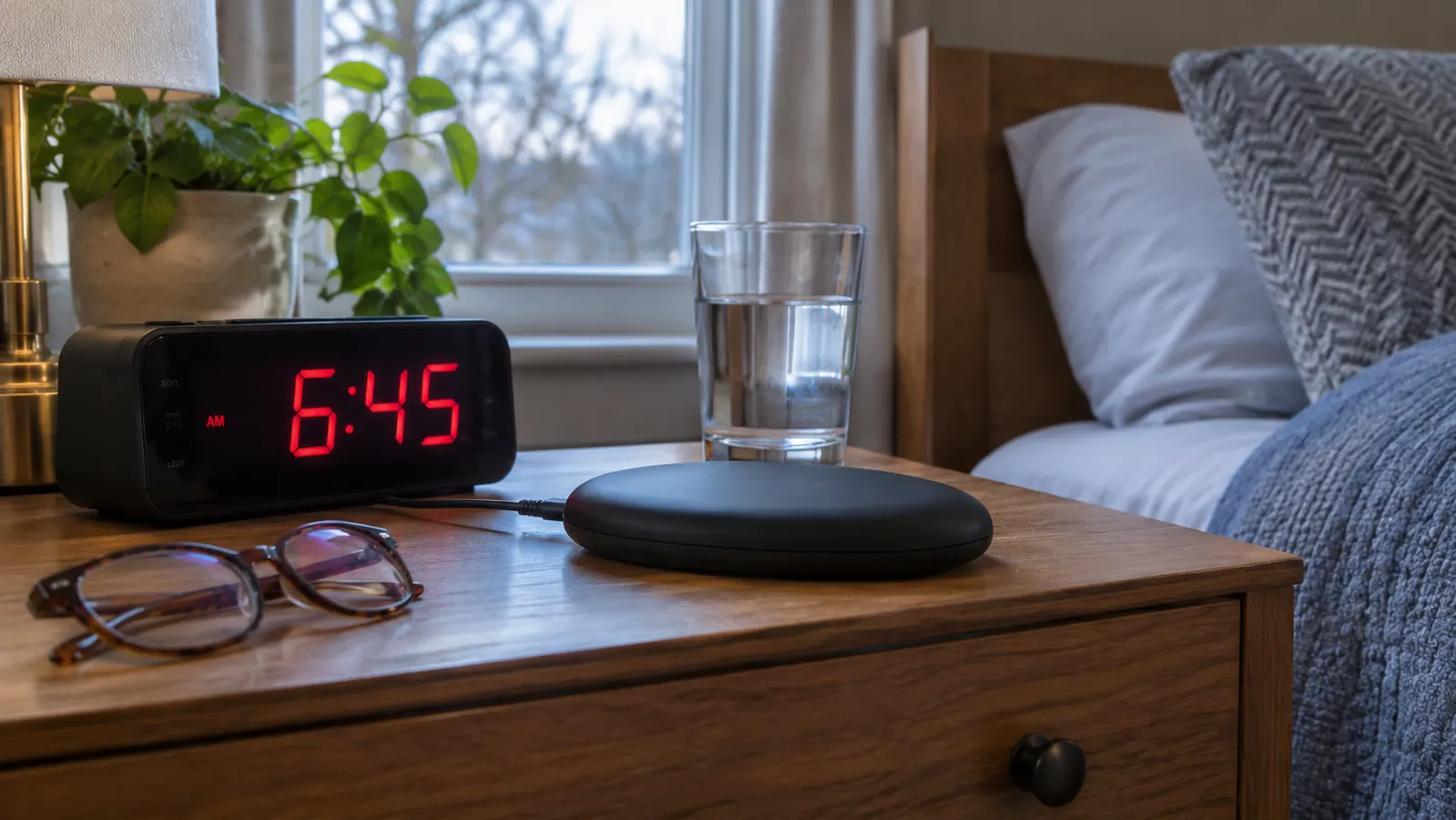
For thirty-eight years I woke up to a job whistle, a foreman yelling, or a radio turned up loud enough to rattle the window. Then I retired, and the waking up got harder, not easier. My hearing went the way hearing goes when you spend four decades around saws and compressors. High frequencies first. Consonants. My wife Carol's voice from the next room.
Ordinary alarm clocks stopped being reliable somewhere in my late fifties. Not because I ignored them. Because I genuinely did not hear them. I would come downstairs at seven, Carol would say she heard the beeping at five-forty-five, and I would have no memory of it at all. That is a strange and slightly humbling thing to learn about yourself. What finally fixed it for me was a bed shaker, and specifically the Sonic Alert Sonic Bomb alarm clock. What follows is how I set mine up, the mistakes I made doing it, and what I would tell a friend who was about to try one.
The clock that wakes you by shaking the mattress, not by beeping at a wall
The Sonic Alert Sonic Bomb pairs a 113dB adjustable alarm with a shaker that goes under your pillow or mattress. Battery backup keeps the time through an outage.
Amazon Check today's price on Amazon →Before You Start: What a Bed Shaker Actually Does
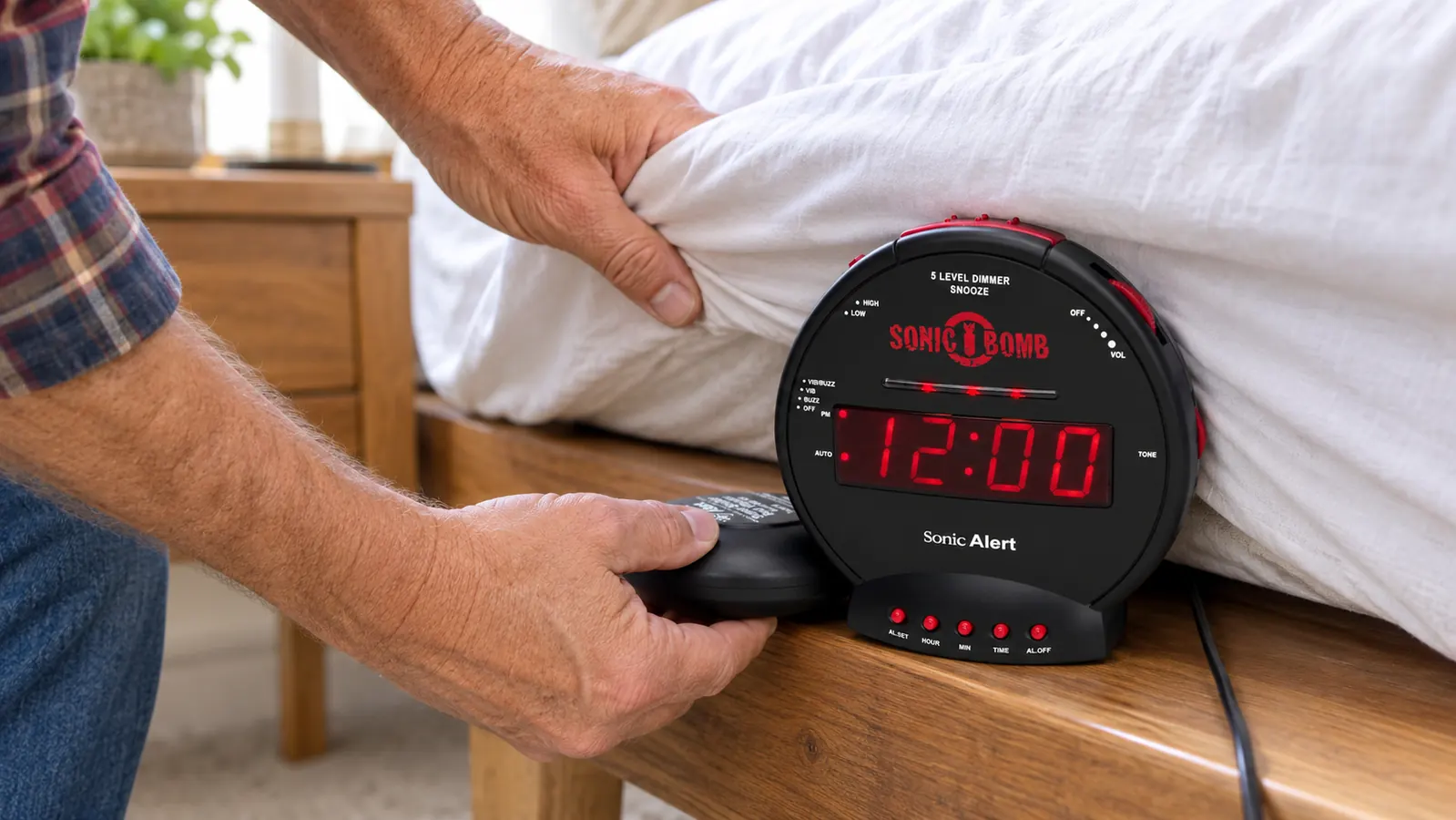
A bed shaker is not a vibrating phone. It is a small motorized puck, roughly the size of a bar of soap, that you tuck under the mattress or the pillow. When the alarm trips, it buzzes hard enough to move through foam and springs. The point is not to make noise in your ear. The point is to reach a sense you still have.
Here is the part people get wrong. The shaker does not replace the sound. The Sonic Bomb runs both at once: the audible alarm at a volume you set, and the shaker going underneath you. You can also turn the sound down and let the shake do the work, which is what I ended up doing so Carol could sleep. The clock body itself is about five and a half inches square and three inches deep, so it needs a real nightstand, not a shelf the width of a book.
How I Set Mine Up, Step by Step
I will walk through this the way I would walk a helper through a wiring job: in order, with the reason for each step, because doing it out of order is how you end up back in bed with a problem.
Step 1: Put the Shaker Under the Mattress, Not on Top of It
My first attempt was to lay the shaker on the mattress next to my hip, under the sheet. That lasted one night. It slid off onto the floor around two in the morning, and I woke up on my own at six-fifteen, which is not the goal. That was a Tuesday in October, the first night I had the thing, and I lay there at six-fifteen feeling like a man who bought a fire extinguisher and left it in the garage. The puck had bounced off the nightstand on the way down. Nothing broke, but I had already learned the main lesson.
The right placement, for me, is between the mattress and the box spring, roughly under where my shoulder sits. Start there. If that is too strong, or too weak, slide it toward your feet or toward the middle of the bed. Mattress thickness matters: a thick pillow-top will eat a lot of the vibration. A firm mattress transmits it clearly. Ours is a firm queen mattress about eleven inches deep, and with the shaker under my shoulder blade I can feel it in my ribs before I can tell you what time it is.
If you are a light sleeper or your mattress is very deep, put it under your pillow instead. That is a much sharper wake, and it is what I would do if I were in a hotel or sleeping away from home.
Step 2: Route the Cord So You Cannot Pull It Loose
The shaker connects to the clock with a cord. In my setup, the clock is on the nightstand and the shaker is under the far side of the mattress, so the cord runs down behind the nightstand, along the bed frame, and up under the box spring. That is about three feet of slack I did not want. Carol measured the run for me, because she is better at that sort of thing, and it came out a hair under four feet from the back of the clock to where the shaker sits. That measures my bedroom, not the cord, but it tells you the run is short and you do not have much slack to waste.
Do yourself a favor and use a couple of those adhesive cord clips, or a twist tie around the bed frame leg. I kicked mine loose twice in the first week by swinging my feet out of bed in the dark. The first time I kicked it loose I was half asleep at two in the morning and thought something had grabbed my ankle. It took me a full minute to work out it was a cord, and I have not swung my feet out that way since. Once you have routed it once, you will never think about it again, but until you do, it is a nightly annoyance.
Step 3: Set the Time and Then Set the Alarm Time Separately
The Sonic Bomb has a dual time feature, which means it keeps two clock times, not two alarms. If you have ever traveled and come home to a clock that is an hour off with no clear way to tell which mode you are in, that feature is for you. Set the primary time to your local time. The second one I keep set to the same time, and that is deliberate. When the two readings disagree, I know the power blinked and I need to reset. It is a poor man's error light, and it has caught two outages for me since spring.
Then set the alarm time itself, which is a separate operation. Read the user guide that comes in the box. I know. But the controls are physical buttons on top, and the sequence matters, and five minutes with the little booklet will save you a week of guessing whether the alarm is actually armed. The buttons are labeled, but they are small, and the print in the guide is smaller. I set mine with a flashlight and my reading glasses and it took about ten minutes.
Step 4: Set Your Volume, Then Your Alarm Duration and Snooze
Here is where the Sonic Alert design earns its keep, and where most people leave performance on the table. You can set the alarm volume separately from the shake. You can also set how long the alarm runs before it gives up: anywhere from one minute to fifty-nine. And you can set the snooze interval anywhere from one to thirty minutes.
My settings, if you want a starting point:
Alarm duration at the long end. If the shake alone does not get me up, I want it going for a while. I set mine toward fifty minutes so it is still shaking when I finally surface, rather than shutting off after two minutes and letting me sleep until nine. Snooze at ten minutes, because five lets me drift back into deep sleep and thirty is a nap. I tried snooze at five for a week and it was worse than no snooze at all, because I would hit it four times and lose twenty minutes in pieces. Ten is enough to feel like a small victory and not enough to fall back under. Volume low, since the shake is doing the work and Carol is asleep beside me.
Then adjust. That is the whole thing. You are not setting a preference once, you are tuning a machine to a sleeper, and it may take a week of small changes to find your numbers.
Step 5: Do a Live Test, Then Put a Battery In It
Before your first real night, set the alarm for two minutes from now, lie down on the bed, and see what it feels like. I am serious. Do this in the daylight, with Carol watching and enjoying it. You will learn two things immediately: whether the shaker is in a spot you can feel, and whether the volume setting is going to bother anyone else in the house.
Then put a 9V battery in it. The clock takes one, and it uses it for battery backup. This does not run the alarm off the battery in normal operation. What it does is hold the time and your settings when the power goes out, which around here happens with thunderstorms in spring. Without a battery, a two-hour outage means you wake up to a clock blinking and no alarm set. With one, you keep your time and you keep your alarm.
What Else Helps
The clock is one part of it. Here is the rest of what actually moved the needle for me, in order of how much difference it made.
Go to bed at a consistent time. This sounds like advice from a magazine in a dentist's office, but it is the single biggest lever. The shaker works best when it is interrupting light sleep, and a steady bedtime is what makes your sleep light at the right hour. The clock cannot fix a random schedule.
Put the clock across the room from the bed. Mine is on the nightstand, which is a compromise, because the shaker cord reaches. If you can get the clock body six or eight feet away with an extension, do it. The physical act of getting up to press a button is worth more than any snooze setting.
Keep the shaker where you can reach it and shut it off. You want the off switch to be easy, because the goal is to get up, not to lie there being buzzed at for forty minutes while you work out the controls in the dark. Learn where the off button is before the first night.
Get your hearing checked. I put this last because it is not a gadget tip, but it is the most important thing on this list. I was sixty-six when an audiologist finally sat me down and showed me the chart. Mild to moderate high-frequency loss in both ears, worse on the left. Knowing that changed how I approached every room in my house, not just the bedroom. I am not a doctor and I am not telling you what you have. I am telling you to go find out, because you can spend a lot of money on alarms before you find out the actual problem.
I came downstairs at seven, Carol said she heard the beeping at five-forty-five, and I had no memory of it. Not ignoring it. Not hearing it at all.
The Mistakes I Made So You Do Not Have To
I put the shaker on the mattress instead of under it, and it fell on the floor. I left the alarm duration short, so it quit before I surfaced. I skipped the battery, and a spring storm cost me a morning. And I ran the volume high for the first week, which meant Carol was awake at five-forty-five even when I was not.
The fix for all four was the same: spend twenty minutes setting it up properly the first time, and tune it for a week. That is not a lot to ask for a reliable morning.
Twenty minutes of setup, then you stop sleeping through your own life
The Sonic Alert Sonic Bomb has a 113dB adjustable alarm, a bed shaker, alarm duration from 1 to 59 minutes, snooze from 1 to 30 minutes, and a 9V battery backup. Set it once and tune it.
Amazon See the current price on Amazon →