
The thing nobody tells you about hearing loss is that it turns your living room into a negotiation. Carol goes to bed around ten and I stay up with the ballgame, and somewhere in the late innings I would notice the volume had crept up high enough that I was probably keeping her awake anyway. Not because I like loud television. Because the crowd noise sits right on top of the announcer and I cannot pull the words back out of it. That is the problem I went shopping to solve, and it is the only problem worth judging the Avantree Ensemble against. This is not a piece about whether the headphones are nicely made. It is a piece about whether a 71 year old retired electrician with high frequency hearing loss can follow a ballgame at a reasonable volume without running his wife out of the room.
I am not an audiologist and I am not going to play one here. Thirty eight years around job site noise did what it does, and I got my hearing checked at 66 the way a person should. Mild to moderate high frequency loss in both ears, worse on the left. Consonants are the hard part. Women's voices and children's voices are the hard part. Two people talking with music underneath them is the hard part. If that is your house, keep reading. If you have never had a hearing test, put this down and go get one first, because no product on this page fixes a problem nobody has measured.
The Quick Verdict
One job, done well: clear television dialogue at my own volume, with Carol in the room and nobody arguing about it. It asks one thing of you first, that your set has an optical or 3.5 mm AUX output, and it genuinely will not work if it does not.
Amazon Check Today's Price →Before You Order Anything, Look at the Back of Your TV
The Avantree Ensemble needs an optical (TOSLINK) jack or a 3.5 mm AUX output. Mine has optical, which is the cleaner of the two. If your set has neither, this is the wrong product and I would rather tell you that now than have you find out on a Tuesday night with a cold cup of coffee in your hand.
Amazon Check Today's Price on Amazon →How I've Used Them
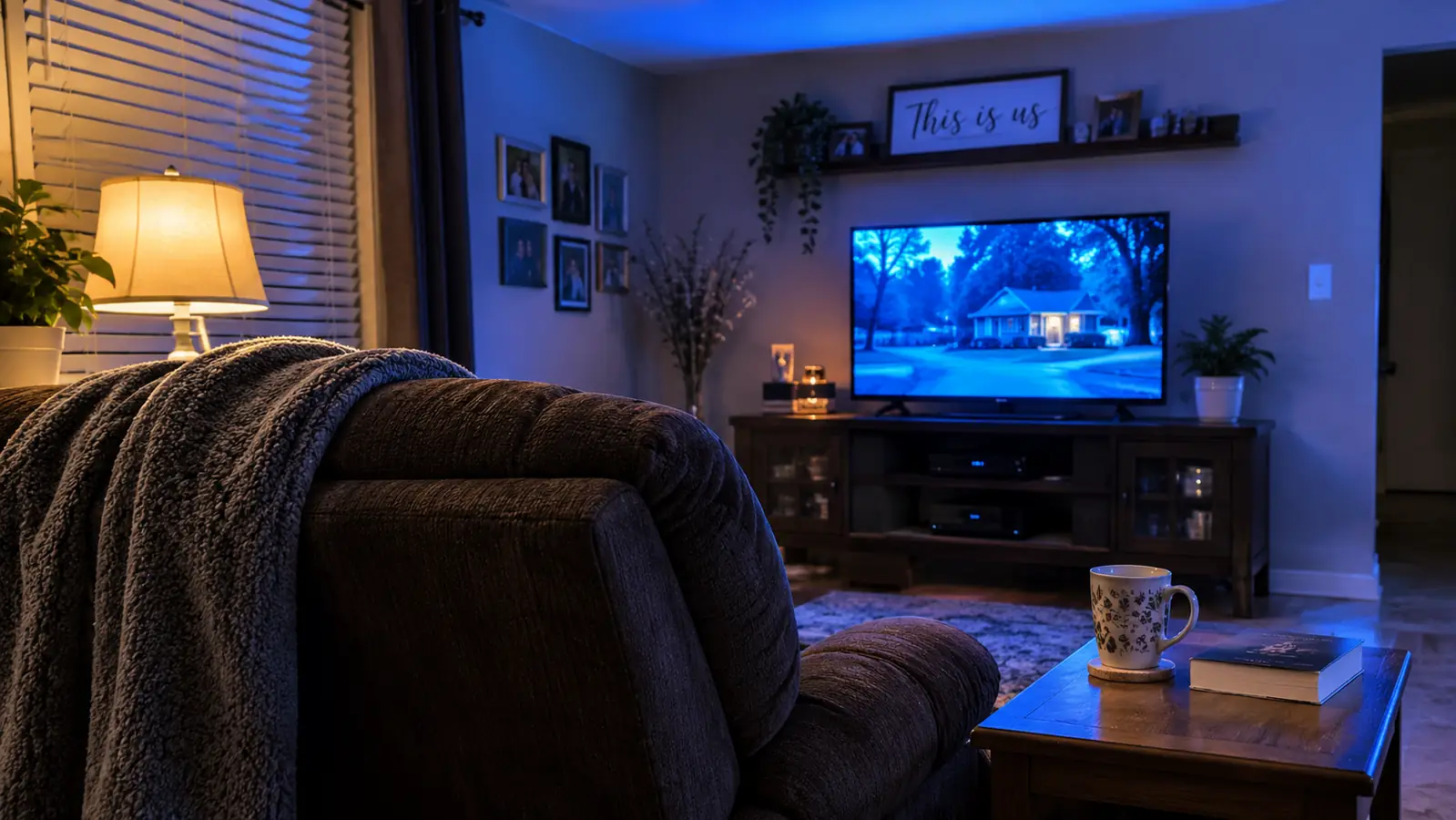
The recliner sits about eleven feet from a 55 inch set in the living room, which is an ordinary distance and an ordinary setup. The transmitter lives on the second shelf of the television stand, about four feet of optical cable from the jack, and I tied that cable to the back of the stand with two zip ties after it slid down behind the DVD player twice. I kept a tally on the calendar for the first month, the way I used to log hours on a job: twenty two nights out of thirty, average two and a half hours a night, almost all of it between seven and nine thirty. The six thirty news, ballgames, the Sunday service we stream on the television, and the old movies that come on after the news when I should already be asleep. That is the whole testing protocol. No bench, no meter, no lab coat. Just the same chair, the same wife in the same room, and a fair number of evenings where I was paying more attention to the sound than to the program.
The first night went badly and I want that on the record, because most reviews skip straight to the part where everything worked. I put them on, turned them up, and got sound that was louder but not clearer. The dialogue was still buried under the music. I sat there for twenty minutes thinking I had wasted my money and maybe gotten a little older in the process. Carol asked how it was going and I said fine, which is what a man says when he does not want to admit he has been beaten by a piece of consumer electronics.
The second night went better, and the difference was not the headphones. It was one setting in the television menu that I had never once looked at in nine years of owning that set. More on that in a minute, because it is the single most useful thing I can tell you about this product, and it is written in the listing in a line that most of us skim right past on the way to the pictures.
What Nobody Tells You: Your TV Has to Cooperate
Here is the plain version. The system connects to your television through an optical cable or a 3.5 mm audio cable, and the transmitter takes that signal and hands it to the headphones. If the television is not sending audio out of the jack you plugged into, you get nothing, or you get a hiss, or you get sound with no voices in it. My set was pointed at the wrong output and I spent a whole evening convinced the hardware was bad and the money was gone.
Before I found the menu I tried the obvious things, in the order a person tries them. I unplugged the optical cable and blew on the end of it, a habit from years of working around dusty equipment, and it changed nothing. I moved the transmitter off the shelf and onto the top of the stand in case the cabinet was blocking the signal, and that changed nothing either. I paired the headphones to the transmitter again from scratch, three attempts and a good deal of squinting at a small light in a dim room, and that changed nothing. Then I unplugged the whole thing and put it back together, which is the electrician's version of turning it off and on, and that also changed nothing. The hardware was never the problem. The television was sending its sound to its own speakers and nowhere else.
Once I went into the menu and told the television to send audio to the optical output, the voices arrived. That was it. One dropdown, nine years of never touching it, and a night of muttering at a charging dock. The listing does say this, up near the top, in a line about checking compatibility and setting the TV audio correctly. I read that line afterward, which is the way most of us read instructions, and I am not proud of it.
So the honest warning is this. Check the back of your set before you order anything. You need an optical jack, the little square one with the shutter on it, or a 3.5 mm headphone style output. If you have neither, stop right here. Nothing Avantree or anybody else sells in this corner of the market will help you, and you will spend a week blaming the wrong thing while your television sits there doing exactly what you told it to.
The Dialogue Question, Answered Plainly
Can I hear the words. That is the only question that matters, and the answer is yes, mostly, with conditions. With the transmitter on the optical output and the volume set on the headphones themselves, the announcers come apart from the crowd. The music comes apart from the talking. I run them well below the volume I used to need from the speakers, and the difference is not a small one. It is the difference between catching the play by play and catching the general shape of it.
The first clear night was a Thursday game with the crowd loud enough that I would normally have had the set up around 32 or 33. I had it at 14 that night with the headphones on and heard the color man explain a pitching change without leaning forward in the chair. I looked at that number twice to make sure I was reading it right. Nothing about my ears changed between the Wednesday and the Thursday. The only thing that changed was which jack the sound was leaving the television through, and whether it was crossing eleven feet of room to get to me or arriving at my ear.
The clearest proof I have is not a number. It is Carol, reading a book in the same room through nine innings without once asking me to turn it down. For years the television volume was a small daily argument that neither of us wanted to have and neither of us knew how to stop having. It is gone. That is worth more to me than any figure printed on the box.
Where they do not save you is a bad mix. If a show was put together with the music louder than the voices, the headphones faithfully reproduce that decision. I notice it on the old movies and on some of the streaming drama the grandkids recommend. What the Ensemble gives you is your own volume and the sound delivered at your ear instead of thrown across eleven feet of room. For the news, the ballgame and the Sunday service, that is enough. For a movie mixed by somebody who clearly did not care, it is only partly enough, and I do not believe any headphone at the current asking price fixes that.
Carol read a book in the same room for nine innings and never once asked me to turn it down. That is the whole review, really.
What These Are Not
I want to be careful here, because I have read reviews of this kind of product that quietly suggest it will replace a hearing aid, and that is not true and it is not fair to the reader. These are headphones. They take the sound your television is already making and put it at your ear at a volume you choose. They do not make your ears better. They do not sort out which sounds matter. If your loss is moderate to severe, or if you cannot follow a conversation across the kitchen table without the television on, that is a different conversation and it belongs in an audiologist's office, not in a review written by an electrician.
What they did for me is narrower and more useful than that. They gave me back the six thirty news without making Carol miserable. They gave me back the ballgame. They gave me back the Sunday service, which I had more or less given up on because the hymns drowned out the sermon and I was mostly watching people's mouths move. That is not a medical outcome. It is a decent evening, and at 71 I will take a decent evening.
The Dock Is Why These Are Still on My Table
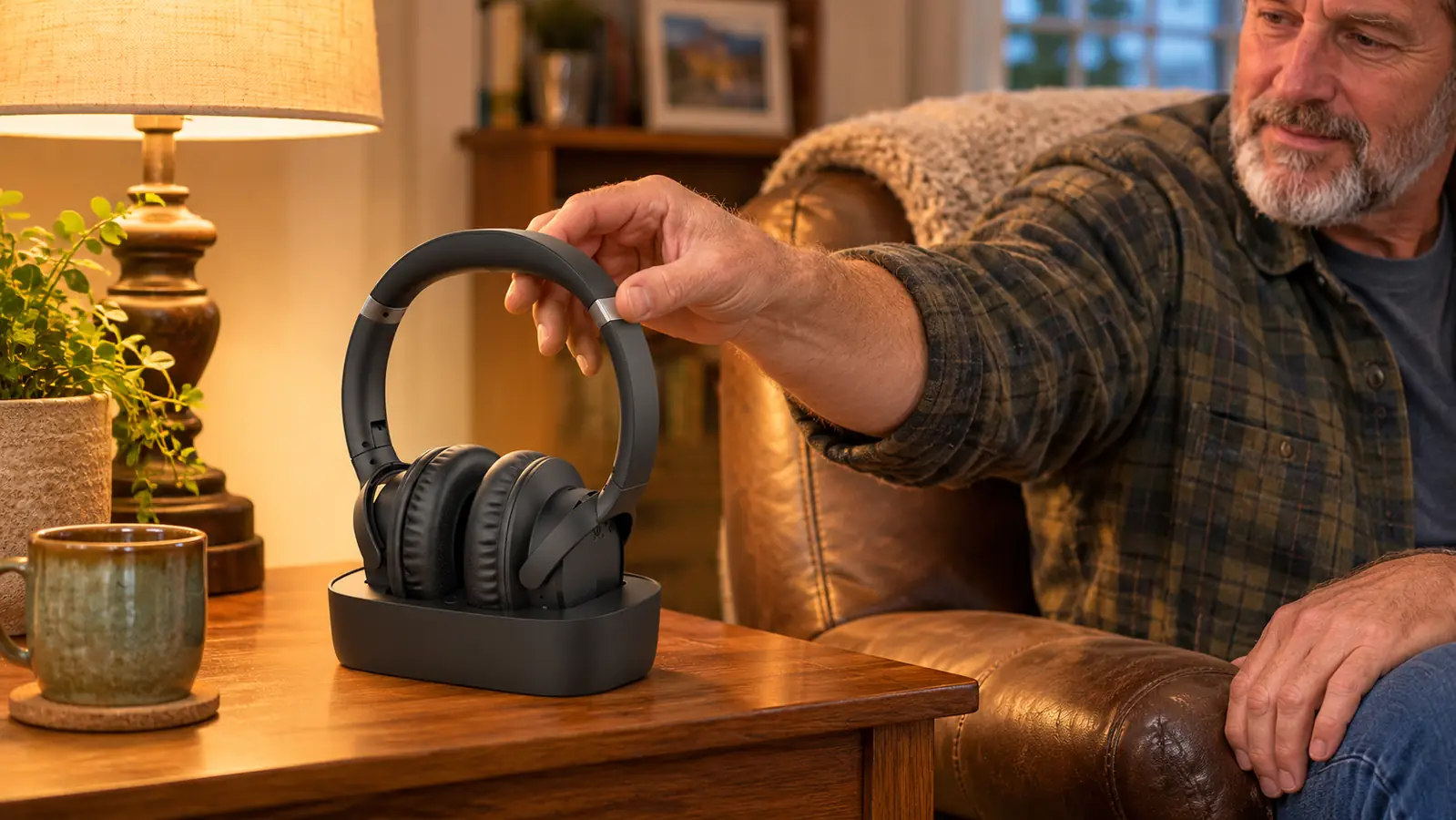
I did not expect to care about the charging dock. I have bought gadgets before that lived in a drawer by the third week, because charging them was one more thing to remember at the end of a day when I am already tired. The dock sits on the side table. The headphones go onto it when I stand up and come off it when I sit down. That is the entire interaction, and it is the reason the Avantree Ensemble is still in the living room instead of in the drawer with the others.
The other small thing is the fit. Over ear cups that sit around the ear rather than pressing flat against it, at 234 grams, light enough that I forget I have them on during a two hour game. I wear glasses and the cups settled around the arms without complaint. If you have ever pulled a pair of headphones off after an hour with a headache starting up behind your ears, you know why I am bothering to mention the weight at all.
Where the Avantree Ensemble Falls Short
The isolation cuts both ways. Passive noise cancellation on an over ear cup means the room gets quieter, which is a fine thing when the furnace kicks on mid sentence and a less fine thing when Carol says something from the kitchen. I have gotten up twice thinking she was talking to me and found out she was talking to the dog. If you need to stay tuned in to the room, this is a real tradeoff and you should know it before you buy rather than after.
The touch controls took me a couple of nights. There are no big obvious buttons to find by feel, and I brushed the side of the cup more than once and changed something without meaning to, then had to work out what I had done. It happened again on a Tuesday during the weather, when I reached up to scratch behind my ear and muted the whole broadcast. Carol noticed before I did and asked why the man had stopped talking. I have gotten more careful about where my hand goes since then. That is a design choice rather than a defect, and younger hands will not think twice about it, but at 71 I would have preferred a raised button I could locate in the dark without taking the thing off my head.
And the warranty runs twelve months unless you register the product, which extends it to twenty four. Register it. I do that with everything now, but I have skipped it before and regretted it, and this is one of those small chores that costs ten minutes and buys you a year of not worrying.
What I Liked
- Voices come apart from crowd noise and background music at a volume I set myself
- Carol can read in the same room again, which ended a small nightly argument
- The charging dock turns it into a habit instead of a chore
- Over ear cups at 234 grams stay comfortable through a full ballgame, glasses and all
- Passive noise cancellation knocks down the furnace and the refrigerator hum
- Simple to live with once the television is set correctly
Where It Falls Short
- Will not work on a television with no optical or 3.5 mm AUX output
- Setup is not plug and play, the TV menu has to be right first
- Touch controls are easy to brush by accident and hard to find in the dark
- The ear cups quiet the room, so you hear your wife less, not more
- Twelve month warranty unless you remember to register it
- Does nothing for a badly mixed soundtrack
Who This Is For
This is for the person who can pass a hearing test and still cannot follow dialogue when there is music underneath it. The one who has been nudging the volume up for years and knows exactly why the person on the other end of the couch is annoyed. The one who has a television with an optical or 3.5 mm AUX output on the back and has never looked at it. If that is you, this does the job, and the learning curve is one evening and then nothing. You put them on, you hear the words, and the rest of the house goes back to its own business.
Who Should Skip It
Skip it if your television has neither of those outputs, because it cannot help you, and that is the first thing in the listing for a reason. Skip it if what you actually need is a hearing aid, because these are headphones and they will not tell your brain what it is missing. Skip it if you need to stay fully aware of the room, because the cups will quiet things down whether you want them to or not. And skip it if you will not spend ten minutes in a television menu, because otherwise you will decide it is broken when it is doing precisely what it was told.
One Setting, Then Nine Innings of Peace
Check the back of your set for the optical jack first. If it is there, the rest takes an evening and then it takes care of itself. Mine has been on the side table since spring, and it is the only piece of gear in this house that ever stopped an argument before it started.
Amazon Check Today's Price on Amazon →