
I spent thirty-eight years on job sites with a hammer drill screaming six feet from my head, and I paid for it later. The audiologist told me at sixty-six that I had mild to moderate high-frequency hearing loss in both ears, worse on the left. Consonants go first. The S sounds, the T sounds, the F sounds. Women's voices and children's voices get thin and slippery, and any TV dialogue with music underneath it turns to mush.
Carol has normal hearing. She got tired of the volume sitting at 42 on a 55-inch set eleven feet from my recliner, and I got tired of cupping my hand around my ear like a man at a county fair. That is how I ended up with the Avantree Ensemble, a wireless headphone set that runs off a transmitter plugged into the TV. I am not an audiologist and I will not pretend this fixes hearing loss. What it does is move the sound from across the room to two inches from my ears. Here are ten reasons that matters in daily life.
Hear the dialogue without turning the whole house up
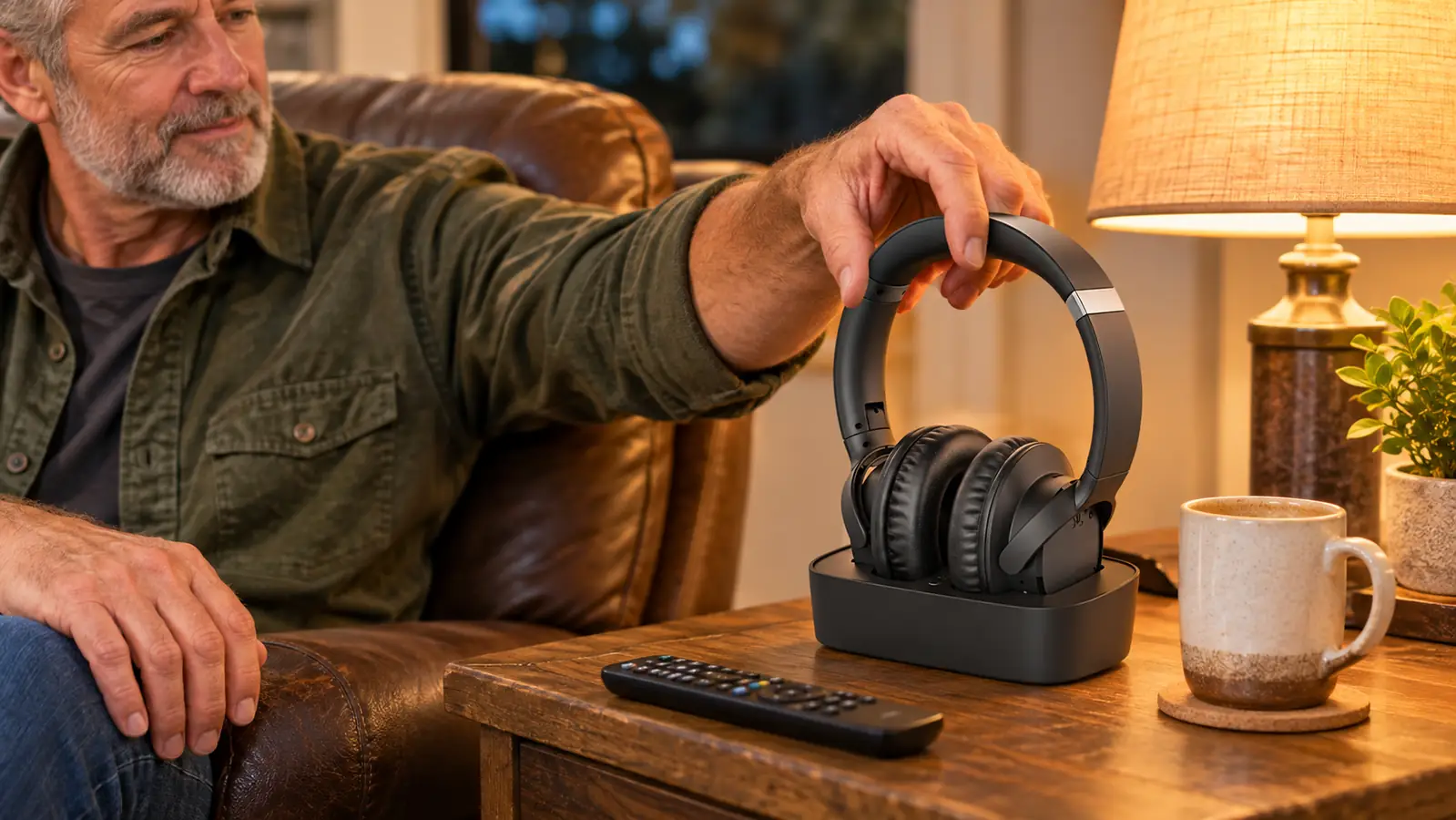
The Avantree Ensemble is an over-ear wireless headphone set with a charging dock and a transmitter that plugs into your TV's optical or 3.5 mm jack. 4.3 stars across 15,523 ratings.
Amazon Check Today's Price on Amazon →Your volume stops being a negotiation
For years the TV volume was a tug of war in this house. Carol's hearing is normal, so at a level I could follow she was getting up to leave the room, and at a level she liked I was leaning forward and guessing. The Ensemble splits that argument in half. The transmitter sends the sound to the headphones and I set my own level on the earcup while the room keeps whatever level she wants. Nobody wins and nobody loses. After all these years I can tell you that is the best available outcome.
The tail ends of words come back
Most of what I lose is the front end of a word. The T, the S, the hard C. My audiologist explained the mechanics of high-frequency loss and I will not do a worse job of explaining it than she did. What I can tell you is that when the sound arrives at my ears instead of being shouted across eleven feet of carpet, the ends of words stop falling off, and a forecast stops sounding like one long mumble. That is the whole difference between following a show and giving up on one.
The lip sync stays put
The transmitter pulls the audio off the TV through the optical output, so what I see and what I hear stay together. I test these things the way I test everything, which is by watching the weatherman point at a map. His mouth moved and his voice moved with it. If you have ever sat through a set where the sound lands half a second after the picture, you know why that matters. Half a second is the difference between watching television and watching a badly dubbed movie.
The dishwasher stops winning
The cups are over-ear, and they knock down room noise the old-fashioned way, with padding and a decent seal. Passive noise cancellation is what the listing calls it. No electronics doing the work. The furnace coming on, the dishwasher running, the neighbor's mower: all of it drops back a couple of notches. What I noticed most is that I stopped cranking the volume around seven in the evening, which is exactly when this kitchen is at its loudest.
The dock means it is always charged
Every wireless thing I have ever owned has died at the worst possible moment. These do not, because the headphones sit in a charging dock when I am not wearing them. I drop them in the dock after the ten o'clock news and they are ready the next evening. That sounds like a small thing. It is not a small thing. A dead headphone five minutes before kickoff is the entire problem in miniature, and the dock is the entire fix.

The earcup controls are touch, not tiny buttons
The controls on the earcup are touch, which means there are no pinhole buttons to hunt for with a thumbnail while the show is running. I am seventy-one and these hands spent four decades inside work gloves, and I still get it done without taking my eyes off the screen. Carol asked me to turn it down in the middle of a movie and I did it in one motion. She did not have to ask twice, which she will tell you is a first.
234 grams on your head, so you forget it is there
234 grams. That is the listed weight, roughly half a pound, and the fit sits over the ear rather than pressing on it. I have worn them through a Saturday double feature and through two hours of a ball game, and the top of my head has not complained once. Weight matters more than people think when you are past seventy and your neck is already doing its best work. Light enough to forget is the whole test, and these pass it.
You can still hear the room
Passive cancellation means the world does not vanish when you put them on. Carol says my name from the kitchen and I hear her. The dog whines at the back door and I hear that too. Compare that to earbuds shoved in with the volume up, where you are effectively alone in the house. I want to watch television. I do not want to trade one kind of deafness for another. The room stays. The dialogue just gets louder than the room.
The evening news and the ball game both hold up
News is wall to wall talking heads with a music bed underneath. A ball game is crowd noise with one announcer on top of it. Those are the two hardest listening jobs on television and they are the two I actually care about. On the Ensemble, the announcer stays in front of the crowd instead of behind it, and I can follow a called strike without pushing the volume to 42. Forty-two was the number on my set before all this. I am glad to see the back of it.
Setup is one cable, if you get the TV setting right
Avantree puts the requirement in plain language on the listing: your TV needs an optical or a 3.5 mm AUX output, and the TV audio output has to be set correctly or the system will not work. That is the honest part, and I suspect it sits behind a good share of the complaints. Mine went in behind the set in about ten minutes. Do yourself a favor and set the TV audio output to the optical jack before you decide the thing is broken.
What I'd Skip
A soundbar, for one. It makes the whole room louder, and the room was never the problem. Earbuds, for another: fine for a podcast, miserable for two hours, and easy to lose in a recliner cushion. Anything that wants me to open a phone app before I can change the volume. Anything that has to be paired by hand every single evening. I would rather have one thing that sits in a dock and works when I pick it up, and that is what the Avantree set is. What I would skip hardest is the idea that turning it up is a solution. It is not a solution. It just moves the problem onto Carol.
Eleven feet from the set, dialogue was a rumor. Two inches from my ears, I catch the T sounds and the S sounds again.
Ten reasons was my list. The ten o'clock news is yours
Over-ear wireless headphones, a transmitter for your TV's optical or 3.5 mm jack, and a dock that keeps them charged between evenings. Get the TV audio setting right and you are done in ten minutes.
Amazon See It on Amazon →