Three weeks after I hooked the ZVOX AccuVoice AV157 to my 55-inch set, Carol said something I had not heard in years. She said the television was too quiet. I wrote it down on the back of a receipt so I would not forget it. For five years the running argument in this house was volume. I kept it at 34, she wanted it at 18, and neither of us was being stubborn for the fun of it. I have mild to moderate high-frequency hearing loss in both ears, worse on the left, from 38 years of running conduit and pulling wire around job-site noise. An audiologist told me that when I was 66. Consonants go first. Women's voices and children's voices go right after them, and then the background music swallows whatever is left.
That is the problem this little bar is built for, and it does address it. But an honest review has to cover the parts the product listing does not say out loud, and there are four of those that matter once the thing is sitting in your living room. I am not an audiologist and I am not going to play one on a website. If you have not had a hearing test, get one before you buy any speaker, including this one. What follows is one retired electrician's account of a few months with a ZVOX on his TV stand in Rolla, Missouri: the evening news, a few Cardinals games, two phone calls the grandkids put on speaker, and Sunday service streamed on the laptop when the roads were bad.
Before this, I did what most people do. I turned the set up until I could follow it, which worked fine until Carol walked in. I looked at the cheap single-speaker boxes that sit under a television and boost everything at once, and I looked at the headsets. I did not want a headset, because half of watching television in this house is turning to the other person and saying something about it. A bar that lifts the dialogue out loud, in the room, for both of us, was the shape of the fix I wanted. That is what the AV157 is trying to be.
The Quick Verdict
The 12 levels of voice boost are real and setup took me ten minutes. Supervoice helps with scripted drama and flattens crowd noise on sports. Optical or analog outputs only, so check your TV's back panel before you order.
Amazon Check Today's Price →Twelve levels of voice boost, and level 7 is the one that got my evening news back
AccuVoice voice boost, Supervoice for background noise, and optical and analog cables both in the box. Rated 4.1 by roughly 2,300 buyers.
Amazon Check Today's Price on Amazon →How I've Used It, Night After Night
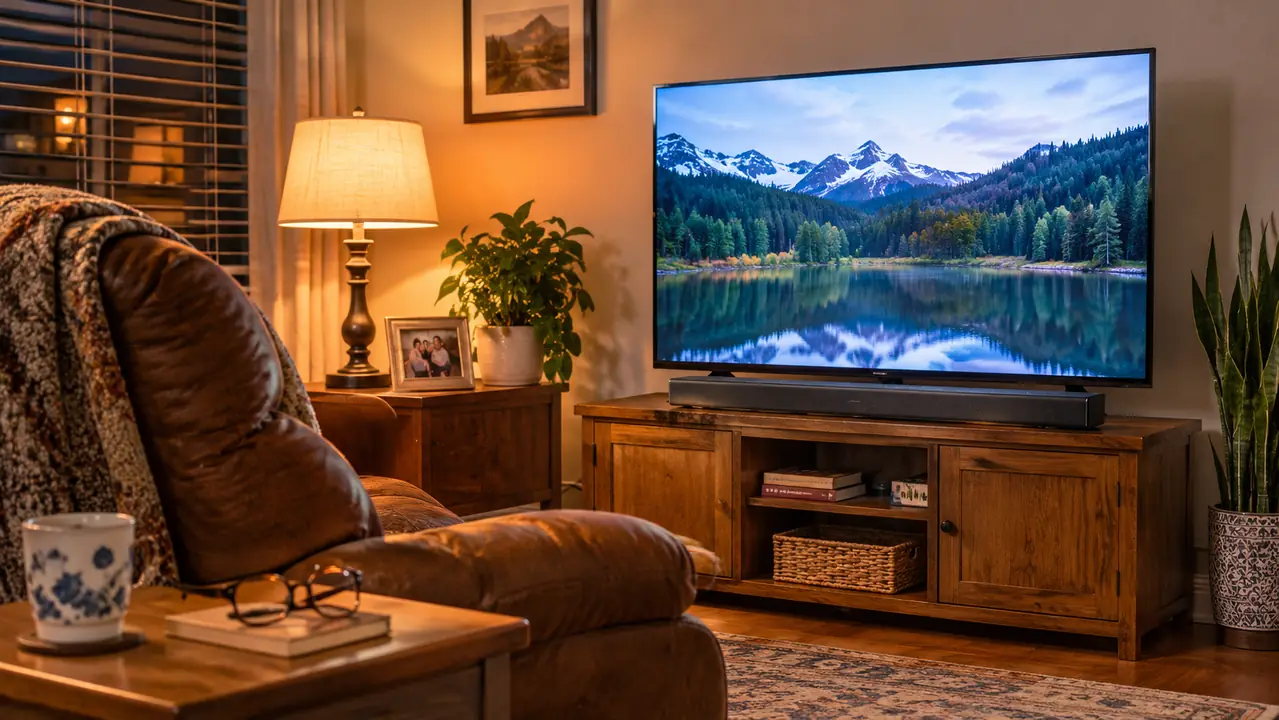
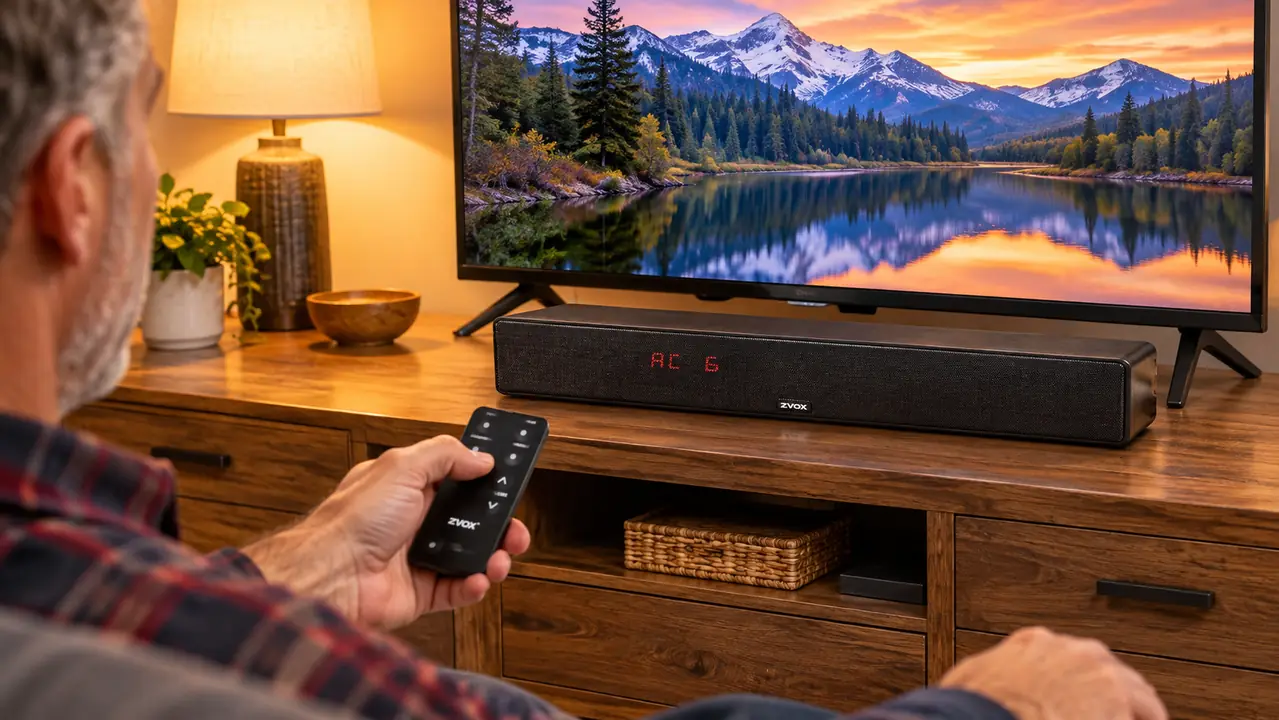
My television is 11 feet from my recliner in a one-story ranch house, which is not a big room and does not need a big system. The AV157 measures 19.75 inches wide, 4 inches tall and 7.75 inches deep, and it weighs 3 pounds. That matters when you are 71 and sliding something onto a shelf by yourself. The enclosure is plastic, it is corded, and it stays put. It is not going to follow you into the kitchen, and it does not need to, because the television does not follow you into the kitchen either.
The connection is the first thing to check and the first thing people skip. ZVOX lists this bar as compatible with televisions that have a Toslink optical output or an analog output, either 3.5mm or RCA, and all the cables come in the box. It is not compatible with a television that has no audio outputs at all. My set has an optical output on the back, so I ran the optical cable, plugged in the power, and had sound in under ten minutes. That included finding my flashlight. My set is a 55-inch from 2019, and the optical jack sits in a tight cluster on the back left corner, upside down from where my hand wants to go. I got the cable seated on the second try. If your set is wall mounted and there is no room to reach behind it, have somebody take a picture of that panel with a phone first. It will save you a knee.
Everything runs off the remote. There is no account to make and nothing to connect to the internet. At my age I count that as a feature and not a missing feature. The remote lives in the side table drawer with my reading glasses and the television remote, and I have gotten into the habit of putting it back in the same spot, because a soundbar you cannot find is a soundbar stuck at whatever setting it was on when it went missing.
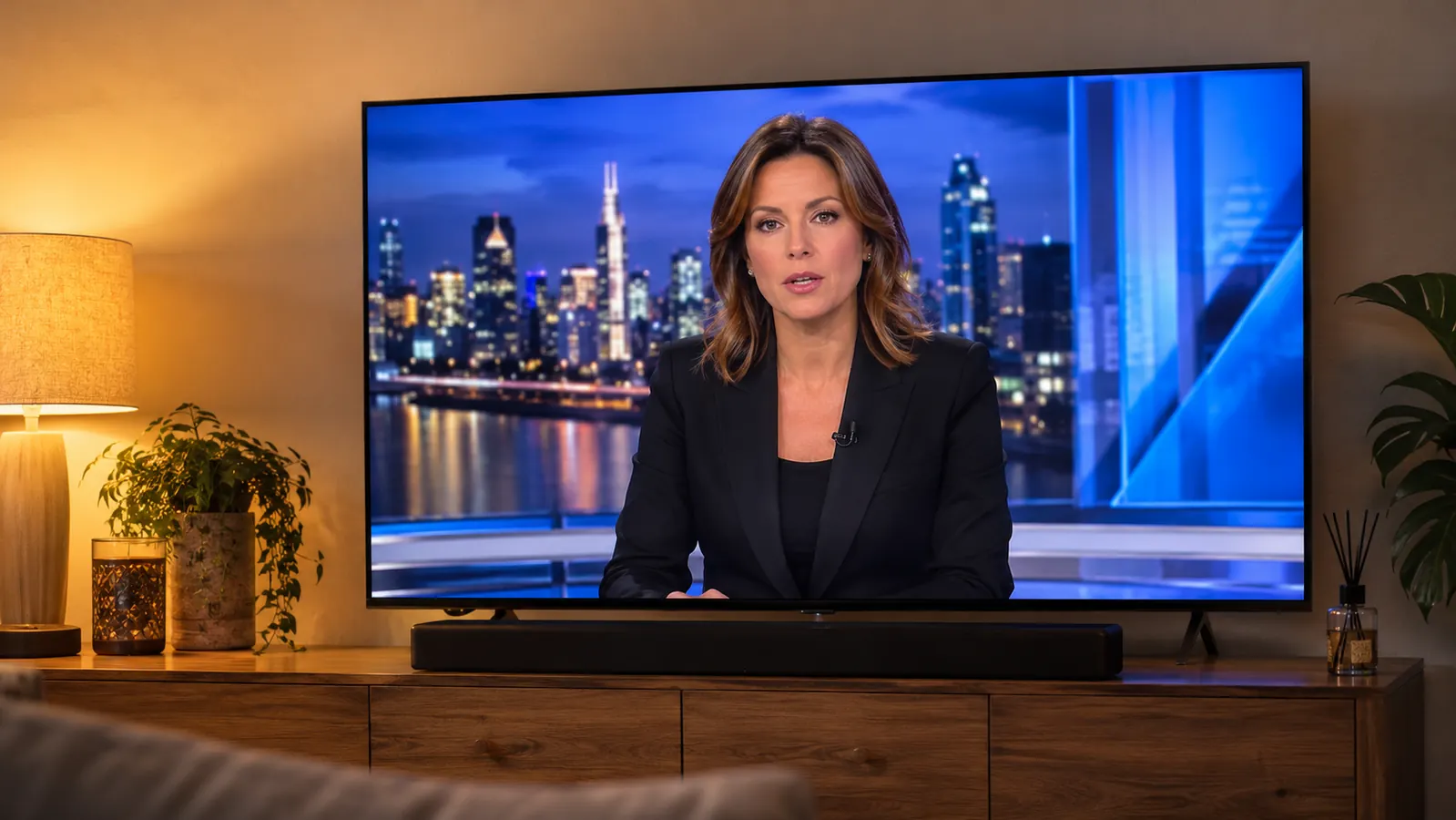
The first night I ran it, I started at level 5 on the evening news and worked up. By the weather I was at 7, and I could hear the difference between the word rain and the same word said a different way. That sounds like nothing until you have spent five years guessing. Carol came in, sat down, and did not reach for anything. That is the whole test in this house. We sat through the entire half hour. About a quarter of the way in I stopped thinking about the setting, which is how I knew it was right. When a thing is working you quit noticing it, and I had been noticing the volume for five years.
What the 12 Levels of Voice Boost Actually Do
AccuVoice is the voice boost, and there are 12 levels of it. I expected three settings that all sounded the same and a lot of numbers printed on a box. That is not what happened. Level 1 is barely a nudge. Level 6 is where speech starts to separate from the music behind it. Level 12 is loud and thin and I would not watch a whole program there. What I ended up with is a short list: 7 for the national news, 9 for the detective shows Carol likes where the score is louder than the actors, and 4 for a ballgame. A ballgame does not have a dialogue problem, it has a crowd problem, and the fix for that is different.
Here is the part nobody puts on the listing. The higher levels do not simply turn up the voices. They tilt the whole bar toward speech, and everything else gets thinner. At 9, a music cue sounds like it is coming out of a coffee can. I noticed it for a week and then I stopped noticing, because I am not watching the detective show for the music. If you are the sort of person who watches a movie for the soundtrack, you will notice it and you will not care for it. If you are the sort who wants to know what the detective just said, you will make that trade without thinking about it twice.
The other thing I will say plainly: it does not fix a bad mix. Some shows are put together so the dialogue sits under the music and the effects, and no amount of voice boost puts the words back where they were never placed. The bar gets closer. It does not get all the way. I still turn on the captions for two shows on Sunday nights, and I am not embarrassed about it. A tool that gets you most of the way is a good tool. It is not a cure.
One more detail worth the ink. The level holds where you left it. I set it for the news, and the next night the news came on at the same setting. I did not have to hunt for it every evening, which is the sort of small thing that decides whether you keep using a piece of equipment or leave it on a shelf. The only time I have gone back to change it was the night a storm warning cut into the ballgame and the anchor came on over a weather map with an alert tone running under her voice. I dropped to 5 for that and put it back to 4 when the game returned. Two button presses, and I did not miss the first pitch.
The bar gets closer to the words. It does not get all the way, and I still use captions on two shows. That is an honest trade at 71, not a failure.
The Supervoice Tradeoff, and What It Does to a Ballgame
Supervoice is the second tool on the remote and it works on a different principle. It reduces background noise so the voices come forward. On a drama with a lot of ambient sound, wind, traffic, a crowd in the background of a scene, it does what it says it does. Carol and I watched two episodes of a mystery with it on and neither of us asked the other one what was said, which is a first around here.
On a football broadcast it does something peculiar. The crowd noise gets stepped on and the game starts to feel like it is being played in an empty stadium. Carol hated it. I used it for two nights and then went back to plain AccuVoice for sports, and I only bring Supervoice out for the scripted shows. The first was a Sunday afternoon game in September, and by the second quarter I had stepped the crowd down so far that I could hear the announcers taking a breath between plays. It did not sound like a stadium. It sounded like two men in a quiet room describing a game they were watching somewhere else. The second try was a college game that same month and it was worse, because the band came through flattened too. That is not a defect exactly. It is a tool with a shape, and the shape does not fit every program.
Placement matters more than I thought it would. The bar is 4 inches tall, so it slides under most screens without covering anything, and at 3 pounds it moves with one hand. Mine sits on the stand in front of the set rather than mounted. There is hardware for a bar mount if you want it, but the stand was built by Carol's father and I was not going to drill into it. I left about a foot between the back of the bar and the wall, and it has been fine for months.
And it is a bar, not a home theater. Under 20 inches wide, 3 pounds, plastic enclosure. It will make dialogue clear. It will not shake the floor during a storm scene and it will not stand in for a subwoofer. I went in expecting clearer words and not more bass, and that is what I got. Anybody expecting the other thing will be disappointed and will write a review saying so.
Where It Falls Short
First, the inputs. Optical or analog, that is the whole list, and if your set has neither, this is not the product for you. No amount of adjusting will make it one. It is the first thing I would check and the first thing I would tell a friend to check.
Second, the ZVOX is a soundbar doing a job people sometimes mistake for a medical device. It makes television dialogue easier to follow. It does not give you back the frequencies you have lost. It does not do what hearing aids do, and it is not a substitute for the appointment. I still use what I use, and the bar is an addition to that and not a replacement for it. Anybody who tells you a speaker can stand in for an audiologist is selling you something I would not buy.
Third, it is one more remote in the drawer. Small thing, real thing. There is about a week where you pick up the wrong clicker and turn the bar up instead of the television, and then your hand learns.
Fourth, and this is the honest one: the improvement is largest on the spoken word and smallest on everything else. Music on a music program sounded worse to me, not better. Effects sound thinner. The bar is a dialogue tool that also plays sound. It is not a sound system that also does dialogue. If your complaint is that the television sounds small, this fixes the wrong problem. I tried a Saturday night concert broadcast once and lasted about eleven minutes. The instruments sounded like they were playing behind a curtain. I switched the bar off entirely and listened through the television speakers the way I always had, and it was better. If music is what you watch, understand what you are buying.
What I Liked
- Twelve voice boost levels that genuinely differ from one another
- Supervoice pulls dialogue out of ambient sound on scripted shows
- Optical and analog cables both included, so setup took me under ten minutes
- 3 pounds and 4 inches tall, easy to set on a stand without moving furniture
- No account to make, no app, nothing connected to the internet
Where It Falls Short
- Optical or analog only, and no help at all if your television has no audio outputs
- High voice boost levels thin out music and effects
- Supervoice flattens crowd noise, which ruins a ballgame
- One more remote to keep track of
- Does not replace hearing aids or a hearing test
Who This Is For
This is for the person whose television volume has turned into a household negotiation. If your problem is consonants, if the news is fine but the sitcom punchlines slide past you, if your set has an optical or analog output, and if you are willing to spend a week finding your levels, this bar earns the space on the stand. Carol can sit through a whole evening at a volume she does not resent, and I can hear what the weatherman is telling me about the roads. That is the review in one sentence.
It is also well matched to a smaller room. Eleven feet from the recliner to the screen is not a big space, and a larger system would have been overkill in it, both in sound and in the amount of stand it takes up next to a lamp that already lives there.
Who Should Skip It
Skip it if your television has no audio outputs, because it will not work and there is no workaround. Skip it if what you want first is better sound for movies and music, because dialogue is the thing this bar does well and everything else is a compromise. Skip it if what you actually need is a hearing test and hearing aids, because a soundbar will not do that job and you will have spent the money in the wrong order. And skip it if you are not willing to change a setting per program, because that is the honest cost of getting the words back.
If you are still on the fence after all that, the one thing I would ask you to do is look at the back of your television. That single check decides whether the rest of this matters at all.
Look at your TV's outputs first, then look at today's price
12 levels of AccuVoice, Supervoice for background noise, and optical and analog cables in the box. 4.1 stars from about 2,300 buyers. If your set has an optical or analog output, this is where I would start.
Amazon Check Today's Price on Amazon →